







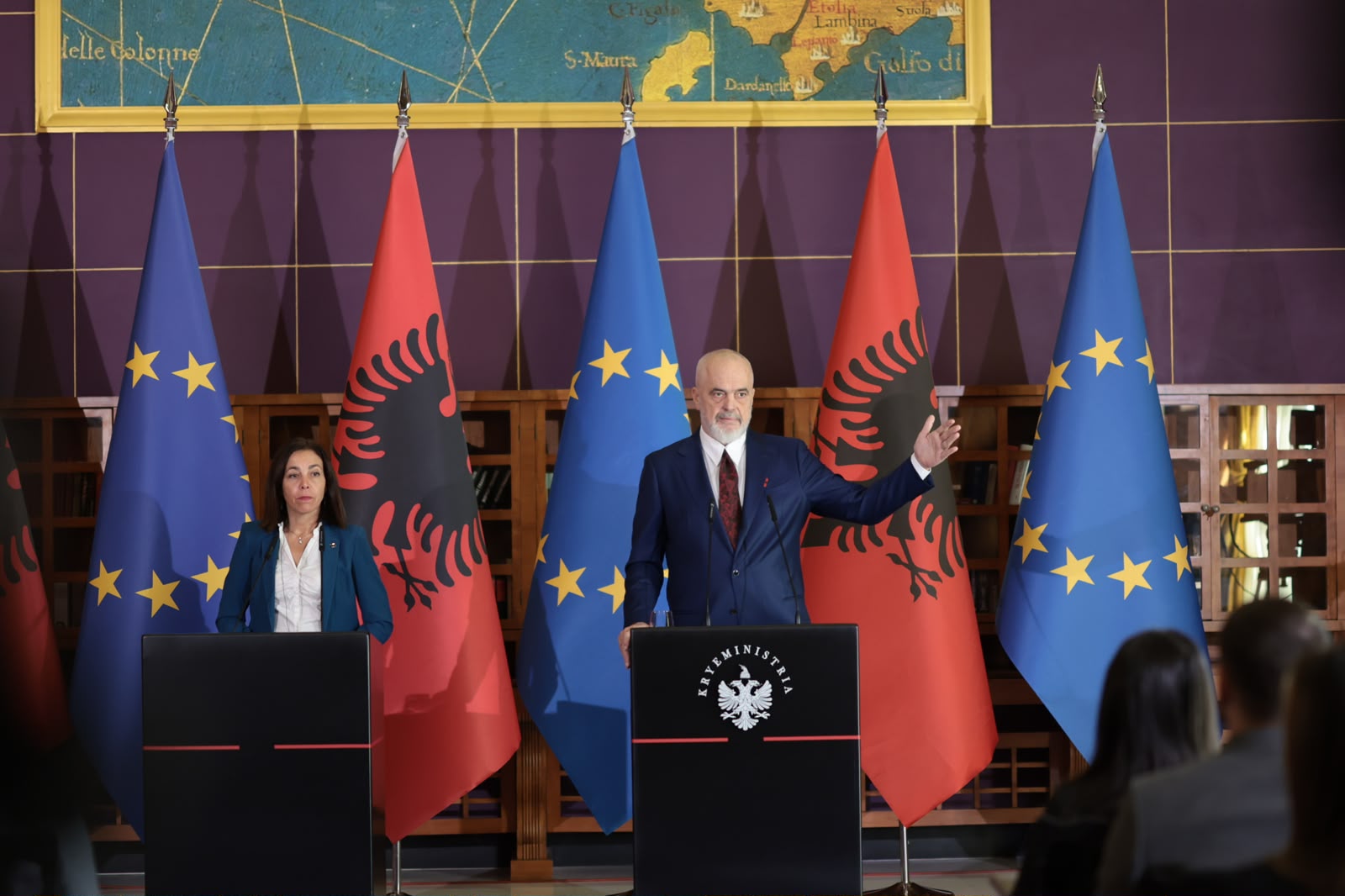
Prime Minister Edi Rama announced this Thursday that he will open an online dialogue window for all citizens who wish to talk with him about issues they consider important. During a conference with the EU Ambassador, Sofia Moreira de Sousa, Rama claimed that three groups of students were obstructed and threatened, online and physically, in their efforts to meet with him. According to the prime minister, the students were bullied after their names were made public.
“Three groups of students were turned back with violence online and offline […] simply for talking. Three groups of students with names and surnames. Exposed and then bullied to the extreme”, Rama said. The head of government warned of legal, criminal and administrative measures against persons who use threats or violence. “Whoever thinks that fear, intimidation, threats or violence will have the smallest impact on me and on our journey has made all their calculations wrong”, he stated. Rama also warned of a response against persons who block roads or use violence against police officers.
Meanwhile, the EU Ambassador to Albania, Sofia Moreira de Sousa, said institutions must create space for dialogue to address popular discontent expressed through protests in Tirana. Moreira de Sousa said violence has no place in a democracy and that any response to acts of violence must remain proportionate and in line with the law.

“It was environmental concerns that triggered the peaceful protests of May, which later turned into a broader movement demanding transparency and accountability, the fight against corruption and good governance. Peaceful protests are part of democratic life, but in this democratic life violence has no place, and any response to acts of violence must remain proportionate and in line with the law. Violence has no place in democratic life. Discontent must be resolved through genuine dialogue, while it is up to democratic institutions to create the necessary space for this dialogue”, said the EU Ambassador.
Questions and answers with journalists
– First question for the ambassador. Madam Ambassador, yesterday in Brussels it was said that Montenegro could be the 28th member state of the European Union in 2028. But it was also said that Albania will be in the same position Montenegro is today next year, with negotiations closed in 2027 and with the accession treaty. Referring to these statements, can we say that 2029 is the year Albania will become an EU member if our country fulfils the reforms? Meanwhile, for Prime Minister Rama: Prime Minister, using your words “the stars continue to be well aligned for Albania”, but for your government the situation is a bit more complex, since for weeks we have been facing a protest demanding your resignation. This protest has been joined by an open war within your political family, where the mayor of Tirana, from pretrial detention, directly accuses you of threatening him with internment, of asking him to resign as mayor, and of doing all of this through the Minister of Justice. Allow me to be direct: have you threatened Mr. Veliaj, and do you think Veliaj is behind the protests? Thank you!
Ambassador of the Delegation of the European Union in Albania, Sofia Moreira de Sousa: Yes, it is true that Albania received the Guiding Roadmap yesterday, which, as you mentioned, has no other deadlines or additional elements, but which takes into account Albania’s aim, as well as the calendar Albania has set for itself to become an EU member state. So, in short, it is possible, but it is a very challenging task. It requires a lot of effort and a lot of work, because the last part is the final pace you have to set for yourself, and this is not only about adopting laws but about implementing reforms, about the discussions that must be held with the whole Albanian society to show what these reforms are, and as you know, we do not have much time. Albania has so far shown that it has the ability to face these challenges and achieve them, so I have no reason to doubt. So we have a set calendar, and everything will depend on the pace and the way these reforms are adopted and how they are implemented. It is important that this be the aim of all Albanian citizens and, since it is such, all citizens should be part of it.
Prime Minister Edi Rama: Thank you for the question. First, I want to say that the Progress Report is, first and foremost, a reflection of the government’s work, and anyone who wants to know what form the government is in reads the Progress Report and finds there the government’s ‘report card’. A report card that makes me happy, because it is very clear that Albania has made great progress, which unfortunately Albanians cannot see on their screens and on the channels of public disinformation.
On the other hand, I want to say that the government is in office and continues to work as I have said before, every day, and when I say every day, I mean exactly every day, toward this objective for which we have gathered here today at this special press conference: the historic objective of the final integration of our country into Europe, and not allowing the loss of a historic opportunity that we have created with an extraordinary amount of work, but which has also been helped by what I call, and what you too have quoted, “the alignment of the stars in favor of Albania and Albanians”. Everything else is like the noise of cars passing back and forth along the boulevard. As important as those things are to us who are here, that is how important to me are the questions you have asked.
– A question first for you, Mr. Prime Minister, citing of course the Progress Report: the European Commission, through the Progress Report, has described the protests that began at the end of May and escalated in October as a large civic mobilisation. Do you think you have responded appropriately to this civic mobilisation, without ignoring or bypassing it, or by labelling external factors or foreign countries as instigators of these protests? And another question: do you think this movement could risk turning into a student movement like the one in Serbia? And one question for you, Madam Ambassador. Do you think political polarisation, the harsh political climate and the protests, should they continue at the same pace, will affect the progress of Albania’s European integration? Thank you.
Prime Minister Edi Rama: Now, as for how similar Albania is to Serbia and the situation in Serbia to the situation in Albania, you can see this by comparing the EU’s stance on the change in Serbia with the major changes Albania has made this year. So these are two realities that have nothing in common with each other, despite the effort to bring them together in service of an agenda that is not the EU’s agenda, is not the government’s agenda and is not the agenda of the governing majority. It is the agenda of those who want to overthrow the government by violence. As for the mass mobilisation, I have said it myself and made the distinction myself between the massive protests in early June and the subsequent degradation of the boulevard into an arena of “crows and ravens”, which could not but lead to violence because it was violent, and without people holding stones and molotovs when the slogan was “no dialogue, resign”. It is legitimate in a democracy for someone to think that way, but totally illegitimate to use stones and fire in the service of that view, while in response to the massive protests we have taken important steps to address what we have read as the reasons for the civic mobilisation. Steps towards transparency.
On this occasion I recall that we have published everything regarding Zvërnec and Sazan and we have not seen any substantive contestation, since everything is on our side, as regards the process followed, the legality and the morality of the Republic we represent in this process. Then, with the new budget, we have directly addressed issues linked to the economic side of people’s concerns, from delivering on a long-standing commitment to reduce VAT on the food basket to 6%, to the direct reduction of the price of petrol at the pump by 32 lek, by moving the circulation tax to the vehicle and removing it from the price composition, and other things I will not list here.
I have heard it described as a return to ideological leftism. These people do not know what they are talking about. It is not a return to ideological leftism, but the creation of opportunities to redistribute more from economic growth. What has long been our main objective and concern is how to redistribute more by growing the economy more. Left and right do not make “the red egg”. Only the economy gives us or denies us opportunities, and our economy grows differently from what might be said; its growth has given us the opportunity to massively redistribute with a new package that would have been completely impossible under other conditions. So we could be ideological leftists, far from it, but we would not have been able to do this, and if we had done it we would have driven the economy into collapse. So this is the reality of the facts. Everything else is like the noise of cars here, coming and going.
And finally, I want to say that I listened to all of you, and to everyone else who has come here below every day, with more attention than anyone. I listened because I was also obliged to listen. While those down there were shouting, cursing, threatening and demanding resignation, repeating non-stop “there is no dialogue,” I was upstairs working with their voices in the background. I know exactly everything that has been said down there, because it has been repeated so many times that I have learned it by heart. I also know those insulting songs with music and all the rest, but I have not been able to take note of a single idea, a single program, a single option for Albania. I take this opportunity at this conference to remind everyone that under no circumstances is the resignation of a democratically elected prime minister, one who is under contract with the people, imposed through the street. In my case, however, there is another specific feature, which is this one here.
Here, the last kilometer of the negotiations is divided into 1,000 meters, and each meter is divided into 100 centimeters, and each centimeter requires the person above the respective field, requires the respective service, requires you to do your respective duty, because here it is written in black on white: “Closing the negotiations at the end of 2027 is an ambitious but achievable objective.” But if this ambitious objective is achieved, it will be achieved by focusing centimeter by centimeter here, not by losing our minds over threatening songs, Molotov cocktails, stones and agendas that have nothing to do with this national mission.
I know it is easy to make irony out of the involvement of foreign actors, but the involvement of foreign actors in the June protest, up to today as we speak, is real. And it was not me or a representative of our institutions, but one of the well-known personalities of France, known for his malicious interventions in democratic countries, who said explicitly a few days ago that “Albania has been part of this hybrid war.”
I have never said that Iran organized the protests, but I have said that the hands of the criminal regime in Tehran are there on the boulevard, and that is backed by facts. And strangely, the Iranian digital army, which we identified as very active in spreading videos of birds, was visible and active in the attack on Paris, so these are facts. The cause is certainly here. Our duty is to address the cause, but at the same time to be aware of what we are doing and to listen to one another, to understand one another, to look at the facts, to mutually acknowledge who is right and who is not right about this or that, instead of rejoicing or getting excited about the virality that the intervention of those who do not want Albania gives to our videos. They do not want Albania to focus here. They do not want 2027 to close successfully for Albania. They do not want us to deal with the centimeters and meters of the last kilometer, but want us to deal with the countless stories that are incited every day, and around which we spin every day in a vortex where, allow me to tell you, the most scandalous, most unacceptable, most unjustifiable and most shameful thing has been the chorus justification of violence. Thank you!
EU Delegation Ambassador to Albania, Sofia Moreira de Sousa: Regarding the question you asked me, and I reiterate here what the Prime Minister said, that the integration process and 2027, we are on the right track. Yesterday we had the Guiding Roadmap to confirm this, but membership is not merely a technical task and does not only mean approving laws; it belongs to the entire Albanian society, and in its report the Commission also explained the largest civic mobilization since the democratic transition, which means citizens demand accountability and good governance. And these concerns are in fact at the core of the accession process. So, peaceful protests are a democratic right, but as I said before, not violence, and violence has no place in democratic life regardless of who it comes from. What is missing today, and you mention it in your question, referring to the polarized society, is dialogue. And all parties, without exception, must make a genuine effort to begin dialogue, and we must fight this polarization, and this can only be done through democratic means: through democratic institutions and by finding the right ways in which citizens’ dissatisfaction is heard and addressed, not through violence once again, but in a way that the whole civil society, media, academics, authorities and institutions address this polarization, and when this happens, it will be reflected in the accession path. So, returning to your question, we also have protests in Europe, in many countries. What is important is to understand what citizens’ dissatisfactions are and to find democratic ways to address them.
Prime Minister Edi Rama: Once again, thank you all very much, and as I have announced, tomorrow we will “turn on another window” on the screens of anyone interested, which is a window of dialogue, a window of dialogue offered to all those who want to interact with me, who want to interact with the government on any issue they consider important; a window of dialogue for students who are threatened by pseudo-students who appear at the doors of lecture halls and deliver violent messages to anyone who thinks differently, behaves differently, or dares to take the step of dialogue. Three groups of students, three have been turned back with violence online and offline by these kinds of pseudo-people, in their effort to come to a meeting with me without cameras, without photos, without a press announcement, simply to talk. Three groups of students with names and surnames, exposed, heaven knows how, and then bullied to the extreme.
I want one thing to be clear to everyone. I am no longer a student, nor a teacher, but I come from a path where I was a student and a teacher, and together with the students I stood against a real regime, not an imaginary regime, for one reason only: to be free to say what I want, wherever I want. Anyone who thinks that with fear, intimidation, threats, or violence they will have the least impact on me or on our path has made all their calculations wrong. On the contrary, they will receive their answer step by step, legally, as is already happening one by one, both criminally and administratively. Including those who raise their hand against the Police and against the state, including those who block roads, which is what they get, and meanwhile do not want to know about thousands and tens of thousands of others who are in their own city, who have the right to move freely in this city and the freedom to do what they want, say what they want, think what they want and go wherever they want.
Read also:
Rama thirrje studentëve: Ju pres nesër, hapim platfomën online për dialog
Ambasadorja e BE: Dhuna nuk ka vend në demokraci, krijoni hapësirë për dialog
A do të jetë Shqipëria anëtare e Bashkimit Europian në 2029? Përgjigjet ambasadorja e BE-së
Rama shpërfill akuzat e Veliajt: Janë si zhurmat e makinave në Bulevard