







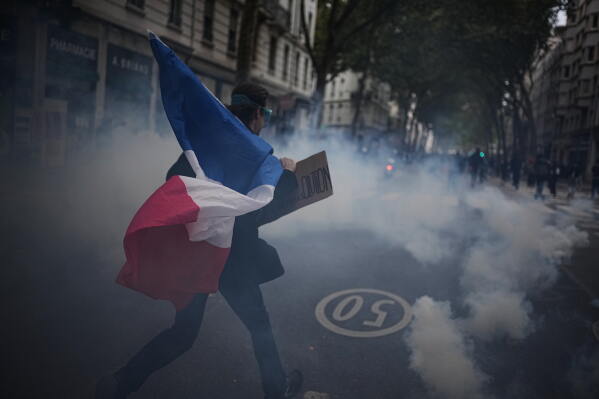
Paris (AP) — Secondary school students in France, who have been protesting for weeks against underfunded schools and an uncertain future, are expressing their frustration at the difficulty of being heard. This comes at a time when young people in aging societies, such as France and the US, no longer carry the same numerical weight as previous generations.
The protests by French students have sparked a national debate over the funding of education, expanding into discontent over the cost of living and police interventions. This reflects a global wave of youth mobilization: in Serbia, student protests brought down Aleksandar Vučić; in Albania, students are joining the anti-government movement against Edi Rama; and Gen Z is also active in India and Nepal. Greta Thunberg, 23, emphasizes that “we are seeing youth rise up all over the world” and that these movements are interconnected.
However, young people are losing ground demographically to older generations, who live longer and are more numerous. Their voice, mathematically, is not as dominant as it once was. In 1968, 9.4 million adolescents and young people made up 19% of France’s population, significantly outnumbering the elderly (13%). This generation, known as the “baby boomers,” born after World War II, experienced an economic boom and major cultural and social changes, becoming a political force in May 1968.

Today, the situation is reversed: 15 million people over 65 (22% of the population) outnumber 9.6 million young people aged 13–24 (14%). The “baby boomers” accumulated considerable wealth, around 9 trillion euros in France, during the “Glorious Thirty” years of economic growth. But they are also leaving behind devastating climate change, record pollution, and a world order shaken by conflicts launched by leaders of their generation, such as Donald Trump, Benjamin Netanyahu and Vladimir Putin.
Gen Z in France inherits record poverty and economic problems, including high public debt, which limits the government’s ability to meet their demands for better schools and more opportunities. Camille Chesnier, 27, a protester in Paris, expresses anger and powerlessness, saying that they don’t know how to make themselves heard.
To strengthen the voice of young people, there are proposals in France to lower the voting age from 18 to 16, supported by Jean-Luc Mélenchon. However, researcher Luc Rouban doubts the political interest and knowledge of 16-year-olds, emphasizing a “rejection of the representative democracy system” among young people.
Despite this, protesting students have learned political lessons, such as building barricades and confronting tear gas, and have also won concessions. Students such as Mathis Aversenq emphasize that their demands reflect those of workers, due to low wages and the difficulty of making a living. Teachers such as Fred Salin and Kamal Hachkar are amazed by the students’ political sophistication and stress their terrible anxiety about the future, in contrast with the ease of life for the “baby boomers” during the “Glorious Thirty” years.
Taken from AP News