







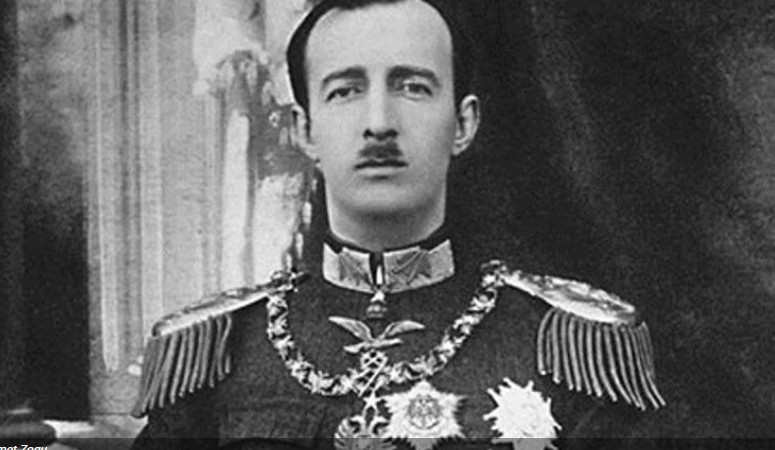
Fischer has described Zog as the architect of the modern Albanian state
This year I directed two rigorous field surveys (funded by German foundations) – one nationwide and the other in urban Tirana. In both, to the question “Which of the six main leaders of the Albanian state of the last century do you value most?”, about 2/10 of respondents answered “Ahmet Zogu”.
None of the respondents had been born before Ahmet Zogu left Albania, yet nonetheless, about 2/10 valued him more than his five most important successors. Since the overwhelming majority of these 2/10 self-declared ideologically as right-wing, it can be surmised that not a few of them chose Zog as their preferred option on the historical stage simply in order not to choose the former communist Berisha (who claims to be right-wing).
Meanwhile, not a few Albanians have knowledge of the two decades when Ahmet Zogu dominated Albania’s political scene.
Let us begin elaborating this thesis with the study published in Albanian by the American historian Bernd J. Fischer, who is among the most well-known international scholars of recent Albanian history. He has conducted in-depth scientific research on the interwar period, and on Ahmet Zogu in particular.

His work “King Zog and the Struggle for Stability in Albania” is one of the most thorough studies of the political structure, the efforts toward state-building, and the challenges faced by Ahmet Zogu, based on archival documents. In his studies, Fischer has shown that Zog’s path to the heights of power faced great challenges, counting some 600 enmities and at least four direct attempts to kill him.
Fischer argues that Zog was a nationalist who resisted Mussolini’s diplomatic maneuvers and ultimatums until 7 April 1939. He characterizes Zog as the principal architect who laid the foundations of an administration and a modern Albanian state, beginning his governing journey from a extremely difficult situation in the country.
It cannot be known how many Albanians have read Fischer’s work, but probably many have heard of him from its readers, while others may have read from other sources about Zog’s era, or may have heard from parents and grandparents about that time.
As a curious reader of history (without being a historical expert), I have read the above-mentioned book by Fischer with attention, as well as many other books on the history of Albanians (published inside and outside the country). Below I give the reasons why I share the same opinion as the 2/10 of the country’s adult residents (that Ahmet Zogu has been the most consequential Albanian leader of the last century, despite his light and shadow).
In 1920, Zog, at 24 years old, with about 3,000 men secured the protection of the new government of the Congress of Lushnjë, and also led the Battle of Vlora to expel the Italians from there.
In the 2,500 years before that year, only Gjergj Kastriot Skanderbeg was recorded as a leader of truly significant weight in the history of Albanian lands. As the first military commander to apply guerrilla warfare effectively, Skanderbeg has been regarded by historians as a thorn in the side of the most powerful empire of his time.
However, he did not manage to create a proper state and administration in Albanian lands. Even the League of Lezhë that he founded was mainly a military alliance, with slight state-administrative nuances. Moreover, powerful leaders such as Lek Dukagjini, Gjergj Arianiti, Pjetër Spani and Gjergj Dushmani soon left the alliance.
Significantly, the only surviving Albanian document from Skanderbeg’s time is the short baptismal formula by Pal Engjëlli (Unte paghesont premenit Atit et birit et spertit senit).
Before Skanderbeg’s time, ancient historians mentioned the Illyrian kings Bardhyl, Agron and Teuta, but more as tribal chiefs than as rulers with proper state structures. No written document has survived from their rule – only occasional inscriptions on grave slabs.
After Skanderbeg’s time, the name of Ali Pasha of Tepelena is clearly recorded in history. But he is mentioned as a rebel pasha who mobilized the Albanians and Greeks of his pashalik against the Sublime Porte (without managing to create a proper state).
The turbulent period of 1912–1920 saw names that governed too briefly to really shape the newborn Albanian state – 14 months Ismail Qemali, 6 months Prince Wied, 15 months Esat Pasha Toptani, and 13 months Turhan Pasha Përmeti.
And so we come to January 1920.
After President Wilson prevented the partition of the Albanian state at the Paris Peace Conference, the most patriotic men of the country gathered at the Congress of Lushnjë to proclaim the new government of Albania within the borders recognized by the London Conference of 1913. But they had only words – the rifles were held by 24-year-old Zog with his 3,000 followers in the mountains. And he, as Minister of Interior of the new government, ensured its installation in the provisional capital, Tirana, and then led the war to expel the Italians from Vlora.
From that time until he left the country, Ahmet Zog was the most powerful man in Albania, regardless of his official post (Minister of Interior, Prime Minister, President of the Republic, King).
At the beginning of his rule, Zog tried to strategically tie Albania to Great Britain (to avoid the influence of our land neighbours), but fate decreed that Albanian oil had a high sulphur content, thereby reducing British interest in investing in our country. He then tried, unsuccessfully, to obtain financing from the League of Nations (again to avoid the influence of our land neighbours). And as a last alternative to avoid the influence of our land neighbours, he accepted financing from fascist Italy, which eventually ousted him from power…
Summing up Zog’s two decades in power in one paragraph, it can be said that he found a country in complete anarchy, with a utterly backward economy and administration, and with a 99% illiterate population. But when he left power, the state and administration had been built on French and Italian models, the education system had extended into cities and many villages, infrastructure and light industry had taken the first steps of development, one could travel freely to Europe with an Albanian passport, and, above all, the general orientation of society was pro-Western.
Starting with Fan Noli, Zog’s strongest political opponent, and continuing to the present day, countless have been his harsh critics. But world history does not know any ruler who has had no opponents or harsh critics – Plato’s “Ideal Ruler” has remained merely an unrealized dream for 2,500 years!
In historical context, a ruler is assessed by the trajectory the country follows during his rule. In Zog’s case, thousands of Albanians (including myself) currently believe that during his rule Albania recorded the greatest upward trajectory – from zero, to a country with functional administration and governance.
NOTE: While about 2/10 of Albanians here value Ahmet Zog more, about 2/10 value the “rightist” Berisha more. On the other ideological side, Rama is valued more by about 3/10 of Albanians here, Nano by about 2/10, and about 1/10 value Enver Hoxha and Ramiz Alia more.