







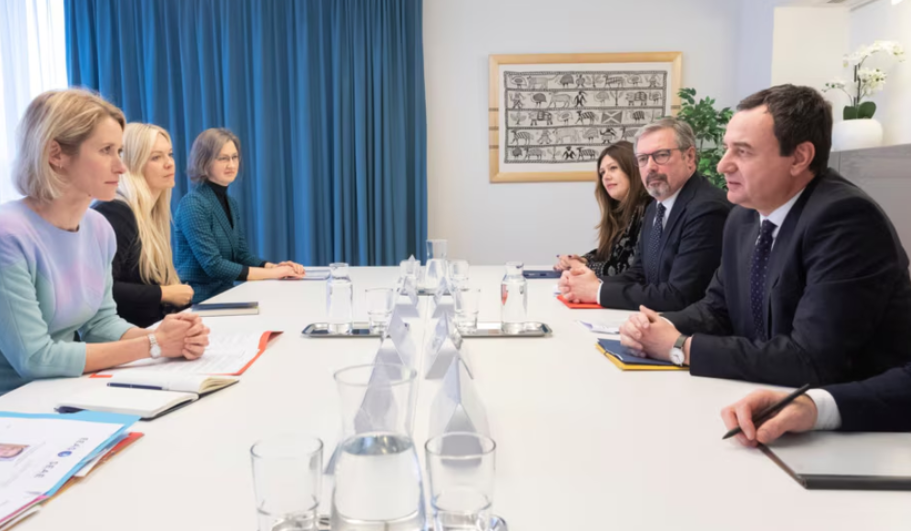
Unimplemented agreements, a blocked political dialogue and new criticism from the European Union.
In this year’s progress reports, the European Commission criticizes Kosovo and Serbia for failing to fulfill their obligations in the process of normalizing relations.
Yet the dialogue mediated by Brussels itself has not recorded significant political progress for more than three years.
The last high-level meeting took place in September 2023.
Since then, talks have continued at the level of chief negotiators, but without bringing the parties closer to a possible agreement.
Pristina conditions the return to high-level meetings on the handover of Milan Radoičić, a former Serbian politician in Kosovo who took responsibility for the armed attack in Banjska in September 2023.
Belgrade, meanwhile, insists on the establishment of an Association of Serb-Majority Municipalities in Kosovo.
Experts following the process assess that the EU still has political and financial instruments to encourage the parties toward normalization.
Yet, disagreements within the bloc and the lack of a clear strategy, according to them, have limited its influence.
Donika Emini, of the Balkans in Europe Policy Advisory Group, says Brussels could use more incentives for both countries, alongside punitive measures.
For Kosovo, she mentions advancing its EU membership application, benefits from the Growth Plan, and financial and political support for integration.
For Serbia, the opportunities mainly relate to the accession negotiations.
“The opening and closing of negotiating chapters, access to European funds, benefits from the Growth Plan and overall advancement in the integration process could be conditioned much more clearly on progress in democratic reforms, the rule of law and the normalization of relations with Kosovo,” Emini told Radio Free Europe.
Toby Vogel, of the Council for Democratization of Policies in Brussels, also assesses that the EU has room to act, but calls for genuine commitment by Serbia to the dialogue and a realistic prospect of reaching a comprehensive, legally binding agreement.
In parallel, he says, Brussels should advance Kosovo’s membership application, which has remained unexamined since December 2022.
“It is appalling that Kosovo’s EU membership application has been sitting in Brussels’ drawers for years and the Commission is not addressing it. No one can convince me that, with the right political will, a creative solution cannot be found that would allow a state, which not all member states recognize, to at least begin the accession process,” Vogel says.
Radio Free Europe asked the European Union questions about the instruments it has available to unblock the dialogue, the possibility of using them and plans for resuming high-level meetings between Kosovo and Serbia, but did not receive a response.
Are financial incentives enough?
For Emini, the promise of funds and financial assistance alone is not enough to convince the parties to engage seriously.
The EU already has the Growth Plan for the Western Balkans, which provides financial support in exchange for reforms.
Constructive engagement in normalizing relations is a precondition both for Kosovo and for Serbia.
Indeed, according to Emini, the experience of 2013 shows that political incentives can have a greater impact.
After the first Brussels Agreement, Serbia was given the green light toward accession negotiations, while Kosovo advanced toward the Stabilisation and Association Agreement.
“I think this logic should be restored, but in a more sustainable and substantive way: real progress in European integration must be accompanied by real commitment to dialogue and implementation of agreements,” she assesses.
Emini calls for more active involvement by the EU’s main member states and a strategy that clearly defines what each party gains if it fulfils its obligations and what consequences it faces if it does not implement them.
Vogel, however, questions whether existing agreements can lead the process toward a final resolution.
“It seems to me that the EU has lost its levers of influence in recent years,” he says.
“Even if these agreements are implemented tomorrow, will they really bring us closer to a final agreement? I’m not sure.”
Does the EU need a new approach?
Criticism of Brussels relates not only to the effectiveness of its instruments, but also to the way it has treated the parties in the dialogue.
In 2023, the EU imposed punitive measures on Kosovo due to tensions in the north and actions by the government, which it described as unilateral. The measures restricted political cooperation and part of the financial support.

According to the 2026 progress report, they were lifted after the regular transfer of local power in the north following the 2025 elections.
Kosovo’s authorities have criticised the EU for applying double standards, stressing the lack of measures against Serbia after the attack in Banjska, a claim the EU has rejected.
Vogel also believes Brussels has exerted more pressure on Pristina than on Belgrade.
According to him, the dialogue has moved away from the goal of a final agreement and has focused mainly on crisis management.
“The EU must change its approach, change the way it treats both parties, and give up the idea that we must give Serbia something so that it accepts Kosovo’s independence, because this is not a concession but an acceptance of reality,” says Vogel.
Emini, meanwhile, attributes the stalling to the lack of political will on the part of the parties, institutional blockades in Kosovo and Brussels’ approach.
“In a way, the impression has been created that Brussels has been content with continued communication at a technical level, while political dialogue has been constantly postponed due to internal circumstances in both countries,” she says.
Can political developments bring a new beginning for the dialogue?
Recent political developments in Kosovo and Serbia may affect the future of the dialogue, but they are not expected to unblock it immediately.
Kosovo already has a government with a full four-year mandate, led by Albin Kurti, which was voted in September after a long period of institutional blockades.
In Serbia, the October elections brought a change of power.
The Student List, emerging from protests against governance, ended the 14-year rule of Aleksandar Vučić.
While Serbia is in the process of forming new institutions, neither Emini nor Vogel expects a high-level meeting during the rest of the year.
Vogel believes Brussels should establish contacts with the new Serbian leadership without immediately putting pressure on it.
“It would be strange, politically, to put pressure on people who are more on your side and much more constructive – or at least that is what we think they are – than we were willing to put pressure on Vučić,” he says.
However, according to him, it will take months to understand the orientation of the new government, as the Student List includes both pro-Western and pro-Russian and nationalist elements.
Emini, too, is reserved about expectations of a change in Belgrade’s policy toward Kosovo.
“It is too early to say whether this change will be positive or negative for the process of normalising relations with Kosovo,” she says.
The Student List, like the previous government in Serbia, considers Kosovo part of Serbian territory, although Kosovo declared independence in 2008.
Its leader, Ilija Srdanović, told REL earlier that continuing dialogue on “the issue of Kosovo and Metohija” is part of its plan.
Kosovo’s Prime Minister, Albin Kurti, has expressed the expectation that the new leadership in Belgrade will change its stance on Kosovo’s independence.
However, it remains unclear whether institutional stabilisation in Kosovo and the change of power in Serbia will also bring progress in the dialogue.
For the EU, this will be another test of its ability to turn political commitments into implementation of agreements./ REL