







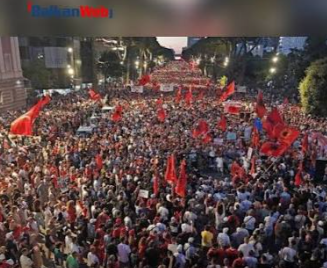
The 28 November protest could be larger than the one on 4 July, but this cannot be predicted with certainty. Preliminary data indicate that organizers are aiming for a broad national mobilization, with the participation of students, citizens from various cities and the diaspora. A two-day rally has been announced, on 28 and 29 November.
The 4 July protest was a strong point of comparison: it took place on the 35th day of continuous protests, gathered thousands of citizens on the boulevard and included participants from Albania and the diaspora.
What could make the rally more massive?
First, the date carries symbolic weight. Independence Day can give the protest a broader meaning than the usual clash between government and opposition: participants can present taking to the streets as a demand for representation, accountability and political change.
Second, organizers are trying to unite several currents. Calls for protest include students, citizens, activists and the diaspora. Reports of diaspora mobilization and support from political parties may increase participation, but they also bring a challenge: will the protest look like a broad civic movement, or like a rally dominated by party actors?
Third, clarity of message matters. The demand for the prime minister’s resignation is strong and understandable, while protesters and diaspora representatives have also spoken of electoral changes and fairer representation. The clearer the demands and the steps required after the protest, the easier it is to mobilize citizens who do not necessarily identify with a party.
What could limit participation?
The protest takes place after several months of rallies and marches. The endurance shows that there is ongoing dissatisfaction, but fatigue may reduce participation, especially if citizens do not see a concrete result. A long protest does not necessarily become larger over time; organizers must create new reasons for mobilization.
Another factor is trust in the organization. Citizens may unite to express dissatisfaction, but not everyone will feel represented by the same leaders or the same political program. The more the protest is seen as an open space for citizens, the greater participation may be. The more it is perceived as the property of a political side, the harder it becomes to expand beyond its supporters.
The conduct of the rally will also affect its size. Reports on 27 November speak of increased security measures and around 2,500 officers on standby. A large police presence does not itself predict the number of protesters; it shows that the authorities are preparing for a day with significant impact in the capital. Calm and safety may help more citizens take part, while tensions or incidents may shift attention away from political demands.
There is reason to believe that the 28 November protest could be among the largest gatherings of this period: the symbolic date, the call for national mobilization and the effort to include the diaspora give it special potential. But to genuinely surpass 4 July, it needs broad participation from the districts, a considerable turnout from the diaspora, good organization and a message that unites citizens beyond party lines.
The size of the protest will be measured on the boulevard; its political weight will be measured by what happens after it. If the rally remains peaceful, with clear demands and organizational continuity, it could mark an important moment. If it begins with violence, it will be confined to violence between them and the police, where anti-government but peaceful citizens will walk away from the protest