







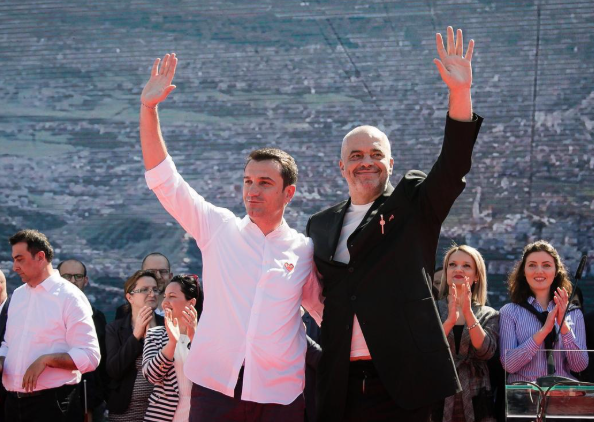
The open clash between Edi Rama and Erion Veliaj has cracked the facade of socialist unity. One is in the Prime Ministry, the other in pretrial detention in Fier, yet now the two face each other in public. The power imbalance is extraordinary; nevertheless, politically, even a man in a cell can impose costs on the one who runs the government.
Veliaj’s letter has taken the conflict to another level. He claims that Justice Minister Toni Gogu conveyed demands and threats to him in the name of the prime minister. Gogu acknowledges the meeting but denies the content attributed to him and says he went to hear complaints about the conditions of treatment. The meeting is confirmed; claims of pressure remain disputed between the parties.
This is precisely where Rama’s political problem begins: why did a visit by the Justice Minister end in a public accusation of interference by the prime minister? What was meant to be resolved, and why did the result become an even bigger conflict?

We have no evidence to say that Rama sought this clash. But we can judge the consequence: a front has been opened within the government’s own political family. And conflicts within power often cost more than attacks from the opposition, because the protagonists know each other, their relationships, and how the system works.
If the aim was to achieve a quiet withdrawal by Veliaj, the public effect appears to be the opposite. He is using the clash to change his position in the debate: from an official who must answer criminal charges, to a socialist who claims he is being punished politically as well. This strategy does not prove his innocence, but it may win him attention and sympathy beyond his circle of supporters. His people in the PS have begun to stir and, apparently though they are afraid of the prime minister’s “sword,” it is again reported that they are moving, albeit still in silence. Because of the power the prime minister once gave him, Erion Veliaj still has friends: deputies, former deputies, former ministers, deputy ministers, former senior officials. They stand and bow to the prime minister, but keep one eye on the prison in Fier.
But continuing to publish the conversation has a price for Veliaj. The long-standing friendship with Gogu would, in ordinary circumstances, call for another kind of restraint. By publishing his own version, Veliaj has shown that he now puts political survival ahead of preserving personal relationships. He has made it clear that he does not intend to leave quietly.
For the government, the response must be documented. Justice Minister Toni Gogu says the circumstances of the visit are verifiable; but they should be clarified publicly if the meeting was recorded. It is said that everything is filmed and recorded in prisons. The longer this story remains between accusation and denial, the more room doubt gains. And people go over to the one who is being persecuted, as Mayor Veliaj says.
Meanwhile, the justice system must determine Veliaj’s criminal responsibility. Political responsibility for this clash is already being judged by the public. And for Rama, the risk is clear: by having Veliaj face him as an open opponent, he may give him precisely the political role that pretrial detention had weakened.
The facade of socialist unity has cracked. Now the question is how deep the crack goes and how many others will find their voice through it. This clash between Rama and Veliaj will create more fissures within the PS, perhaps more than the entire Protest and Opposition front combined.
It is not known who advises the prime minister, or whether he no longer asks anyone, but in times of such quarrels and clashes, especially as we head toward local elections on 9 May 2027, where Tirana will be the municipality that determines the political fate of the majority, Rama should form a new, genuinely political government, with the most prominent personalities of the left, and should appoint a candidate for Tirana who is not a party functionary but someone from civil society./Spiten Prulli/