







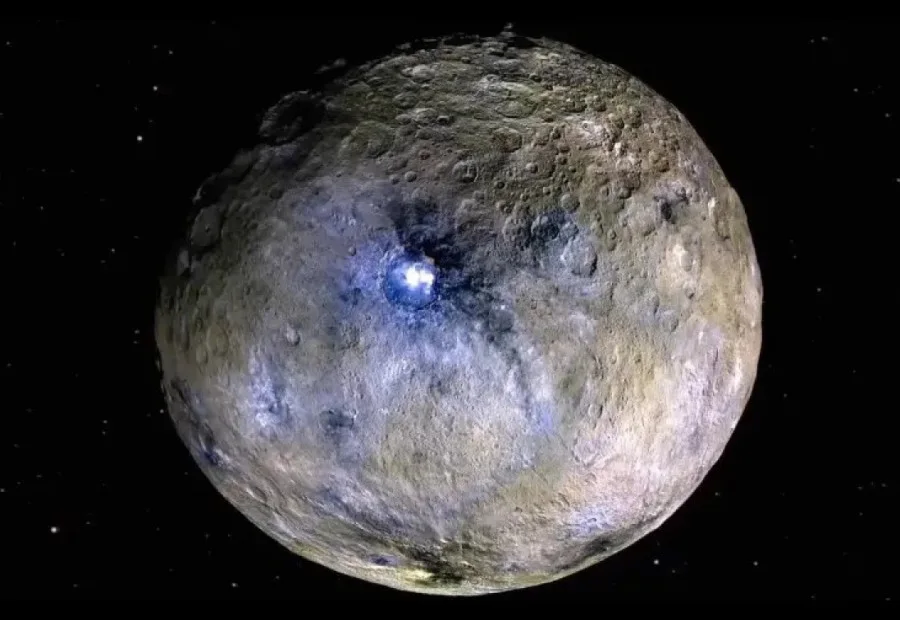
Dwarf planet Ceres, located in the asteroid belt between Mars and Jupiter, once had the conditions necessary to support life forms. This conclusion is suggested by a new study based on NASA data, published in the scientific journal “Science Advances”. The study confirms the presence of a possible source of chemical energy on this celestial body, Newsmax Balkans writes.
According to the study, extraterrestrial life may have been much closer to Earth than previously thought. Scientists have not found direct evidence that life existed on Ceres. The results nevertheless indicate that three essential elements may once have been present there: water, organic molecules and energy.
The key data were provided by NASA’s “Dawn” mission, which studied Ceres from orbit during 2015-2018. The spacecraft identified bright areas on the surface. They turned out to be salt deposits left by salty water that once rose from underground.

Beneath the surface, it is thought that a subsurface ocean existed on Ceres with salty water and organic molecules, basic components of life. ## How Ceres’s interior may have functioned Through thermal and chemical models, researchers reconstructed how Ceres’s interior may have functioned over billions of years.
The study was led by Sam Courville, a doctoral student at Arizona State University. According to simulations, about 2.5 to 4 billion years ago, radioactive decay in the rocky core produced enough heat. This heat drove the circulation of hydrothermal fluids toward the subsurface ocean.
These fluids contained hot water, dissolved gases and minerals. On Earth, similar environments are found near hydrothermal vents at the bottom of the oceans. There, certain microorganisms obtain the energy needed to live through chemical reactions rather than from sunlight.
Researchers believe that a similar process may once have occurred on Ceres as well. “On Earth, when hot water from the depths mixes with ocean water, the result is often a rich source of chemical energy for microorganisms. Therefore, it would have important implications if we were to determine whether Ceres’s ocean had a supply of hydrothermal fluids in the past,” Courville explained.
The chances that life still exists on Ceres today are considered low. The dwarf planet is now a frozen world covered in salts. Its internal heat source has long been extinguished, while surface temperatures can drop to -81 degrees Fahrenheit, about -63 degrees Celsius.
The small amount of liquid water that may remain is isolated as brine beneath the ice layers. ## Discovery extends possibilities beyond Ceres The significance of this discovery goes beyond Ceres itself. Researchers suggest that many other small, icy bodies in the Solar System may also have had similar conditions in the past.
These include dwarf planets, moons and asteroids. This opens the possibility that environments suitable for life were much more widespread in the early Solar System than previously thought. The study on Ceres, therefore, does not prove the existence of extraterrestrial life.
It shows that a small world in the vicinity of Mars may have offered the chemical conditions that on Earth nourish microorganisms. For scientists, this makes Ceres a reference point for the search for environments suitable for life on other bodies in the Solar System.