







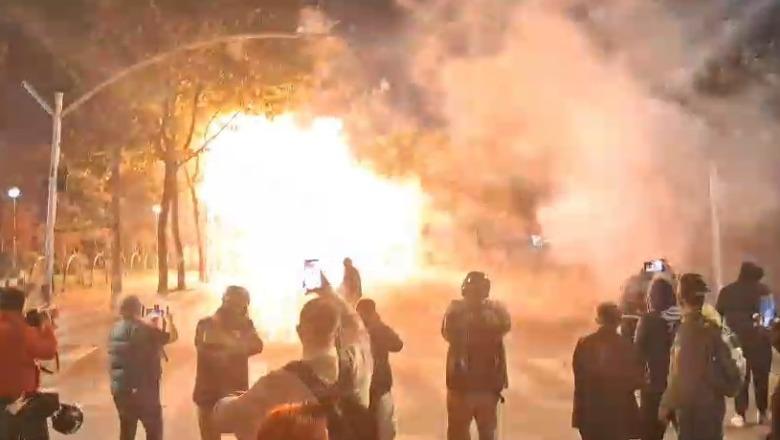
Europe’s streets have filled again this autumn, from Paris and Madrid to Rome and Lisbon, from Athens and Brussels to Belgrade and Tirana. The reasons differ from one country to another — prices, rents, schools, corruption — but the question that unites the protesters is the same: is anyone listening?
Protests across Europe do not share a single list of demands, but they share the same anger at corruption and the rising cost of living. Students demand schools that work, workers want wages that suffice, families want rents they can afford, and pensioners want a little more than what they receive today.
Everywhere, in one form or another, anger at corruption and at those who govern appears. This is not a single protest with one common list of demands: in some countries it is mainly about money, in others about politics; somewhere higher wages are demanded, somewhere the protection of public services.

In Serbia and in Albania, the demand is for the government to step down. According to data from ACLED, the organization that records protests and conflicts worldwide, between 15 September and 30 October France recorded over 1,200 protests and disturbances, Spain 173, Italy 160, Germany 70 and Portugal 33. The number alone does not tell the whole story, since a small gathering and a march of hundreds of thousands are counted the same way, but it gives an idea of the scale of the movement.
In France, everything started with schools, with classes without teachers and poor conditions, and within a few weeks trade unions, transport workers, doctors, nurses and pensioners had joined. On 5 November, the Interior Ministry counted about 575,000 protesters across the country, while the unions said 1.6 million.
The usual gap between the figures does not change the essence: people want higher wages, public services that are not cut, and something concrete against rising prices. In Spain and Portugal the key word is housing, because rents and home prices have climbed so high that many young people, even those with jobs, cannot live independently.
In Italy, workers protest over wages, insecure contracts and everyday bills, while in Belgium, in addition to prices, people oppose changes in social policies and cuts in public spending. On 21 October, in Athens, Thessaloniki and other cities, teachers, pupils and students took to the streets over the funding of education, salaries and the condition of schools.
In Dublin, trade unions and civic organizations protested over the cost of living and the housing crisis, while in Germany economic concerns are mixed with uncertainty about education, work and security policies. On 22 October, tens of thousands of students and university staff marched in Vienna against the insufficient budget for universities.
In Poland, people are taking to the streets for the Constitutional Tribunal and the independence of the judiciary, an issue that has long divided the country. So it is not only about wages and prices, but also about education, institutions and democracy itself. The event that truly changed this autumn happened in Serbia.
## From Novi Sad to the elections: how the Student List was born
Everything began in November 2024 in Novi Sad, when the canopy of the railway station collapsed and 16 people died.
Many Serbs did not see it as a tragedy but as a consequence of corruption and of a state where no one is held accountable. Students demanded an investigation and the names of those responsible; the protests lasted for months and gradually turned into a rejection of the way power had been exercised in Serbia. Then the students did something that rarely happens: they did not leave the protest to the old opposition, nor did they remain only on the streets. They created the Student List, ran in the snap elections of 25 October, and won.
Serbia has shown that a civic movement can move from the square to parliament without dissolving into the old parties, although the difficult part begins now, because winning an election is one thing, and turning protest slogans into reforms and institutions that work is quite another.
Albania resembles Serbia in some respects and not at all in others. The Flamingo Revolution began at the end of May against a luxury tourist complex in Zvërnec, in the Vjosa-Narta area, with the simple demand that this place not be touched and not be handed over to private interests. The protest grew, and before long people were demanding transparency in government decisions, an investigation into suspicions of corruption and, ultimately, the resignation of Edi Rama.
From the start, the movement took care not to attach itself to any party, criticizing the government but also the opposition of Sali Berisha. For the protesters, the problem was not only the name of the prime minister, but an entire way of doing politics in which money and power appear to be the same thing. In October, pupils and students joined, with their demands on university fees, the condition of schools, work and the future.
The protests escalated, there was violence, damaged property and clashes with police; police used tear gas and other means to disperse crowds, while hundreds were reported detained and injured on both sides. The movement also brought to the surface another problem: many people do not trust the alternative either, since for a good part of the protesters Berisha’s return is no solution to Rama’s departure.
That is why it insists on distinguishing itself from both the government and the opposition. Here lies the big difference with Serbia: Serbian students turned their anger into an electoral list that won, whereas in Albania the movement has become visible and its demands have widened, but there is still nothing similar to put into the ballot box.
## Rents and the crisis of representation
Serbia is an example to be studied, not a recipe to be copied.
For decades, Europeans were told that if they worked, studied, they would live better. Today, for many people, that bargain no longer works: you may have a job, even a degree, and still be unable to rent an apartment without help from your parents, or your salary may rise only to be eaten by price increases before you feel it.
Eurostat puts it in numbers: in the second quarter of 2026, housing in the EU cost 4.7 percent more than a year earlier and rents had risen 3 percent, while in Portugal house prices jumped 16.5 percent within a year. Even in the richest countries, having a home of one’s own has become the main worry of the younger generation, and when inflation falls, prices do not come back down.
Governments can show graphs that improve, while families feel no change. Nevertheless, the economy does not explain everything. At the head of many protests are young people, educated, who compare their lives with those of their peers in other countries and organize on social networks rather than in party branches.
They want better schools and universities, work, fair wages and a state where the law applies to everyone. Traditional parties often stay on the sidelines: they try to join the protests, but trust is not won by appearing in the square, as Serbia and Albania clearly show. Behind this lies a crisis of representation, because people vote, yet many of them feel that decisions affecting their lives are made somewhere else, without asking them, and so protest becomes the other way to be heard.
Governments speak of financial stability, investment, security and competitiveness, while people ask what these mean for their wages, pensions, their child’s school, the hospital and the rent. Both sides have a point, but the problem arises when one question always gets an answer and the other is always postponed.
So these protests are not simply revolt against a particular government: they erupt equally where the left, the right or centrist coalitions govern, because beyond the blame of each government there are deeper problems, economic, demographic and institutional. Serbia has already shown how far a protest can go, with a student movement that, without relying on the old opposition, won the elections and a majority in parliament.
This does not mean the same path applies everywhere, but it shows that protest can become more than anger: it can become an alternative. For Albania this carries particular weight, because for years politics has been summed up in the Rama–Berisha duel, while the flamingos and the students have shown that there is a discontent that belongs to neither of them.