







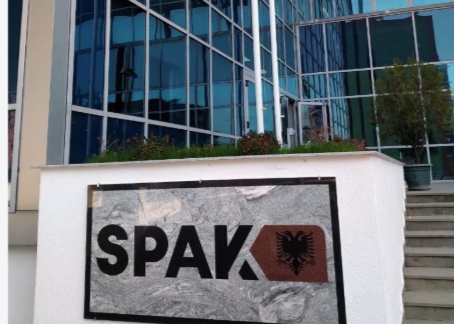
SPAK has sent for trial the criminal organization of Franc Çopja and Ervis Çela. According to the investigation, the organization trafficked at least 60.7 tonnes of cocaine from South America to Europe during 2019–2021, while more than 18 tonnes were seized in five episodes.
As part of the case file, assets and money worth around 9.18 million euros were seized, including a resort in Xhafzotaj and a villa in Dhërmi.
NAMES OF THE 16 DEFENDANTS
Franc Çopja
Ervis Çela
Fadil Balla alias Julian Balla
Riza Çela
Ardjan Çela
Maringlen Mullaj
Petrit Lakatos alias Petrit Sulejmani
Renato Musaku
Gert Çerma
Marenglen Kamami
Soni Pepa alias Vilson Pepa
Albin Çela
Elidon Çela
Denis Daja
Ditjon Pepa
Kujtim Gjyla
Full SPAK announcement
The Special Prosecution Against Corruption and Organized Crime has concluded its investigations and on 5.11.2026 sent to the Special Court of First Instance the request for trial in criminal proceeding no. 187 of 2023, against 16 defendants:
– Ervis Çela, Franc Gergely (alias Franc Çopja), Fadil Balla (alias Julian Balla), Riza Çela, Ardjan Çela, Maringlen Mullaj, Petrit Lakatos (alias Petrit Sulejmani), Renato Musaku, Gert Çerma, Marenglen Kamami, Soni Pepa (alias Vilson Pepa) – accused of committing the criminal offenses “Drug trafficking”, committed in the special form of cooperation, namely of the criminal organization, and “Commission of criminal offenses by a criminal organization and structured criminal group”, provided for by articles 283/a, 28/1 and 334 (paragraph 1) of the Criminal Code; “Laundering of proceeds of criminal offense or criminal activity”, committed in the special form of cooperation, namely of the criminal organization, provided for by articles 287/1, letters “a”, “b” and 28/1 of the Criminal Code; “Criminal organization”, in the form of organization, provided for by article 333 (paragraph 1) of the Criminal Code; “Commission of criminal offenses by a criminal organization and structured criminal group”, provided for by article 334, point 1 of the Criminal Code.
– Albin Çela, Elidon Çela and Denis Daja – accused of the criminal offenses “Laundering of proceeds of criminal offense or criminal activity”, committed in the special form of cooperation, namely of the criminal organization, provided for by articles 287/1, letters “a”, “b” and 28/1 of the Criminal Code; “Criminal organization”, in the form of participation, provided for by article 333, paragraph 2 of the Criminal Code; “Commission of criminal offenses by a criminal organization and structured criminal group”, provided for by article 334, point 1 of the Criminal Code.
– Ditjon Pepa and Kujtim Gjyla – accused of the criminal offenses of “Laundering of proceeds of criminal offense or criminal activity”, committed in cooperation, provided for by articles 287/1, letters “a”, “b” and 25 of the Criminal Code.
– The Special Prosecution has also brought Riza Çela and Albin Çela to trial as defendants for the criminal offense “Illegal construction”, committed in cooperation for profit purposes, provided for by article 199/a/4 of the Criminal Code.
Structure and activity of the criminal organization
Analysis of the investigative data gathered in criminal proceeding no. 187/2023, including communications obtained through the encrypted platforms SkyECC and EncroChat, as well as other evidence gathered during the investigation, presents data supporting the existence and functioning of a criminal organization with international reach, involved in organizing, coordinating and carrying out the trafficking of considerable quantities of cocaine from South American countries to European markets.
The organization includes at least 16 identified persons and many others who have not been identified. The structure appears organized vertically, with cooperative relationships and consolidated links with groups and criminal organizations in Paraguay and Brazil, and has operated at least during the years 2019–2021. From the investigation so far, it has emerged that two Albanian citizens, Franc Gergely, arrested in Belgium, and Ervis Çela, arrested in Albania within criminal proceeding no. 187/2023, exercised co-leadership functions in this internationally structured criminal organization. The data gathered show that this structure had the capacity to control and coordinate different links of the drug trafficking chain, from securing the drug substance in countries of origin, financing and transporting it, to distribution in several European Union states, including Germany, Spain, Belgium, the Netherlands, the United Kingdom and Italy. The circulation of financial proceeds from drug trafficking was carried out in a structured manner, through an international network that used informal money transfer mechanisms, such as Haëala and the token identification mechanism. The activity of this structure extended to several states and relied on cooperative relationships, consolidated contacts and functional division of tasks among the persons involved, as part of the links of the trafficking chain. It focused on securing the drug substance in countries of origin, financing the purchase and transport of it, organizing movement from production areas to collection points and departure ports, preparing and concealing shipments within legal goods, organizing maritime transport to Europe, as well as coordinating the reception, removal from ports, storage, distribution and sale of cocaine in European markets.

In parallel with these processes, the findings point to the use of special mechanisms for financing the activity, managing proceeds, and transferring funds between different locations. In this context, informal value transfer mechanisms are mentioned, including the “Haëala” system, as well as the use of identification codes or tokens to coordinate and verify the handover and receipt of cash sums. The international reach, duration and repetition of the trafficking episodes, together with the use of special logistical and financial structures, indicate an organized and continuous activity, supported by sustained cooperation between the persons involved and a clear division of roles and responsibilities.
From the analysis of communications administered on the encrypted platform SkyECC, available from 29.11.2019, as well as photographic material exchanged between Ervis Çela, Franc Gergely and other associates, data have been identified relating to the organization and carrying out of narcotics trafficking. The communications, in Albanian and Spanish, contain references to the dispatch, receipt, quantities and transportation of cocaine, including its concealment in shipments of legal products exported from Paraguay to Europe. Communications and photographic material related to the circulation of cash sums, the use of the informal money transfer system “Haëala” and “token” identification codes, and through commercial companies engaged in the import and export of legal products have also been identified.
The communications contain references to the companies, products, shipments, commercial documentation and organization of transport. The photographs exchanged show legal products which, in the context of the conversations, are presented as part of the mechanism for transporting and camouflaging the shipments.
Roles
From the analysis of communications and other administered data, Ervis Çela and Franc Gergely appear to have held functions of particular importance in organizing and coordinating the suspected criminal activity.
Ervis Çela was responsible for supply at the places of origin, including contacts with suppliers in Latin America, securing and financing quantities of cocaine, discussing its quality and prices, organizing transport from the production areas to Paraguay, and coordinating road and air transport by small aircraft from Bolivia to Paraguay, in cooperation with other persons involved. Ervis Çela is also reportedly linked to the process of collecting, storing and preparing shipments for export, and to loading the narcotic substance at the port of Villeta, Paraguay.
Franc Gergely was mainly responsible for financing and coordinating the further phases of the activity, including organizing international transport, securing and coordinating the ordering companies for the legal goods used to conceal the cocaine, organizing the removal of shipments from European ports, mainly the port of Antwerp, Belgium, and managing the sale of the narcotic substance in Europe on behalf of Ervis Çela and other associates.
From the communications analyzed, it appears that the cocaine production laboratories in the Andean area, particularly in Bolivia, were referred to by the term “kitchen”. In this supply phase, Ervis Çela appears to have held the central role. His communications with Franc Gergely show coordination between two links: supply, and subsequently financing and international transport. According to the administered communications, after procurement at the places of origin, the cocaine was transported to Paraguay, where it was stored and prepared for export. For this purpose, air transport by small aircraft from Bolivia to rural areas of Paraguay was also used. The communications mention shipments of up to around 500 kg which, upon arrival, were transferred to heavy-tonnage trucks specially designed for transporting the narcotic substance.
After arrival in Paraguay, the cocaine was collected, stored and prepared for export to Europe. According to the administered data, the commercial companies P.T.S.A. and E.P.S.R.L., owned by the citizen D.I.B.C., were used. Through this commercial infrastructure, the narcotic substance was repackaged and concealed in shipments containing legal products such as decorative plaster (stucco), paints and other industrial products. The use of these companies provided a commercial cover for the exports, integrating the transport of cocaine into the regular circulation of international goods.
· Cocaine was purchased at around 4,100–4,200 dollars per kilogram (this price also included transport to the port of Villeta, Paraguay).
· For loading onto the vessel, a further 1,300 dollars per kilogram were paid, in the form of a bribe for the passage of the shipment.
In communications, the term “hipja” (loading) was used to refer to this phase, while the term “dalja” (unloading) referred to removing the cargo from the European destination port. This data shows the existence of defined costs for different phases of transport, as well as the need to coordinate financing among the persons involved in the respective links of the activity.Overall, river and intercontinental sea transport was used. The narcotic substance was concealed within legitimate commercial cargo, placed in containers following the usual export routes. After departing from the Port of Villeta, Paraguay, the cargo is transported via the Paraguay–Paraná river corridor to the Port of Buenos Aires, Argentina, which serves as a transit point and link between river and sea transport. From this port, the containers are loaded onto transoceanic ships of international commercial lines and continue sailing toward European ports. The main destinations identified include the ports of Hamburg, Germany, Antwerp, Belgium, Barcelona, Spain, and Rotterdam, Netherlands.An important element in the way this mechanism operated was the change of container destination during the voyage to Europe, aimed at directing them to ports where conditions had been created to deliver and then remove the narcotic substance.From the analysis of SkyECC communications, an element of particular importance emerges for determining the role of Franc Gergely in the phase of cocaine’s arrival in Europe. Specifically, it refers to contacts and cooperation with persons linked to customs and port security structures in Antwerp, Belgium, including persons who operated the scanner, carried out security services, etc.
According to the identified modus operandi, for each shipment legitimate products were ordered in advance from companies linked to the persons involved. After the containers departed from Paraguay and passed through transit ports, the destination was changed and the delivery port was determined. In this process, Franc Gergely appears as a person with contacts and organizational capacity to coordinate the removal of cargo from the Port of Antwerp. This phase was essential for carrying out the trafficking, as it required the cooperation of transporters, persons with information on the movement of containers, and contacts in port structures. The cost of extracting the cocaine was calculated at 15% of the cargo and was usually settled in kind, through the handover of a portion of it.
After the cocaine was removed from European ports, the Netherlands served as one of the main centers for wholesale storage and distribution, under the coordination of Franc Gergely. From the administered communications, his involvement in coordinating quantities, setting prices, organizing packaging and transport to EU countries, as well as managing payments and dividing profits among the persons involved, is evident. This data indicates that his role extended beyond removing cocaine from the ports, including organizing distribution and financially managing the alleged criminal activity.
One element that highlights the organization of the criminal activity is the use of informal mechanisms for transferring monetary value, referred to in communications as “Haëala” and “token”. The Haëala system enabled the transfer of money across countries through a network of intermediaries, without using bank transfers or physical transport of the funds, while “token” served as an identifier for carrying out and verifying the handover of the amounts. Paraguay, Bolivia, Brazil, Albania, Turkey and Dubai are mentioned as transit points or destinations of these transfers.
The analyzed communications show that the relationship between Franc Gergely and Ervis Çela was characterized by the continuous coordination of the various links of the suspected criminal activity. Ervis Çela secured the cocaine at its source and organized its transport to Paraguay, while Franc Gergely was involved in financing the shipments, organizing sea transport, removing them from European ports and handling the cocaine after its arrival at the destination.
The securing of cocaine and the preparation of shipments for export could not achieve the final objective of the activity without the financing and organization of their transport and removal at the destination. Likewise, these phases required the prior securing of the narcotic substance. Consequently, the data administered support the assessment that Franc Gergely and Ervis Çela exercised decision-making authority over various, yet interdependent, links, coordinating their actions to carry out the common activity. The division of roles does not necessarily demonstrate a hierarchical relationship, but a model of cooperation in which each acted with functional autonomy and responsibility for their respective link.
From the analysis of the administered data, Franc Gergely and Ervis Çela emerge as first-level leaders of the criminal organization, with central roles in coordinating the cocaine trafficking. This leadership level also includes Fadil Balla, who appears to have acted mainly in cooperation with Ervis Çela and other persons subject to investigation.
The second leadership level includes Petrit Lakatos, a close associate and right-hand man of Franc Gergely, with a role in removing shipments from the port of Antwerp, storage, wholesale distribution in the Netherlands and administration of the proceeds, as well as Mikolvan Mullaj, who appears to have coordinated operational activity under the direction of Ervis Çela and Fadil Balla. Each of them had subordinate associates engaged in transporting the narcotic substance, handing it over, collecting money and dispatching shipments to other destinations. This data demonstrates a structure organized into several leadership and operational levels.
Based on the analysis of encrypted communications on the SkyECC and EncroChat platforms, and on their correlation with evidence obtained through international legal assistance requests and information exchanged with foreign authorities, it appears that this criminal organization organized and carried out the international trafficking of no less than 60.7 tonnes of cocaine from South America to various countries in Europe during the period 2019–2021. The scale of this criminal activity, its geographic reach and the volume of drugs trafficked indicate considerable organizational, logistical and financial capacity, as well as an international cooperation network that enabled the procurement of the narcotic substance in countries of origin, its transport via international routes and its distribution in European markets.
In this context, the evidence obtained identified several concrete episodes of seizures of considerable quantities of cocaine, linked to the period of this organization’s activity, specifically:
ü December 2019 – Rotterdam, Netherlands: seizure of approximately 255 kg of cocaine.
ü April 2020 – Barcelona, Spain: seizure of approximately 495 kg of cocaine.
ü May 2020 – Rotterdam, Netherlands: seizure of approximately 300 kg of cocaine.
ü November 2020 – Netherlands: seizure of approximately 600 kg of cocaine.
ü February 2021 – Hamburg, Germany: seizure of approximately 17 tonnes of cocaine.
In total, these five episodes document the seizure of approximately 18,650 kg (18.35 tonnes) of cocaine.
Foreign associates of Ervis Çela, Franc Gergely and Fadil Balla
1. One of the key figures in Ervis Çela’s network of contacts is Uruguayan national with the initials S.E.M.C., who was arrested in Bolivia in 2023 and subsequently extradited to the United States of America. According to the U.S. Department of Justice and the Drug Enforcement Administration (DEA), he is suspected of having led an international organization trafficking cocaine from South America to Europe and laundering the proceeds of this criminal activity.
2. Another close associate of Ervis Çela is the Uruguayan national with the initials F.E.S.V., who is reportedly involved in international money laundering schemes in Paraguay, on behalf of drug trafficking organizations. He mediated the transfer of millions of dollars, obtained from drug trafficking in various European countries, to South America and other destinations. This national was arrested in Paraguay in August 2023, as part of the anti-drug operation “A Ultranza PY”, and was extradited to the United States in July 2024.
3. Among Ervis Çela’s closest associates is also Paraguayan national with the initials D.I.B.C. He owns several commercial companies, which are suspected of having been used for storing, preparing and concealing cocaine in legal products, for further transport to Europe in containers. He is currently the subject of an international arrest warrant.
4. Another Paraguayan national linked to this activity is the individual with the initials A.R.G., currently under arrest, who faces criminal charges in Paraguay and Brazil for alleged involvement in international organized crime. Prosecutors in Paraguay accuse him of international drug trafficking and money laundering. He owned sports aircraft, which are suspected of having been used to transport considerable quantities of cocaine from Bolivia to Paraguay.
5. This network of accomplices also includes the Brazilian national with the initials C.S.L., currently the subject of an international search by Brazilian authorities. He is reported to have been involved, in cooperation with Ervis Çela, in organizing the purchase, financing and distribution of drug shipments, through the continuous supply of multi-ton quantities of cocaine produced in laboratories in the Andean region.
6. Furthermore, the Brazilian nationals with the initials R.P.A. and Th.A.D.B. are reported to have been involved in running the laboratories, setting the quality parameters of the cocaine, and identifying shipments through brand marks stamped on the packages of narcotics. An important indicator of Ervis Çela’s position in this relationship is the willingness of suppliers to make available to him and his associates quantities of 2,000 to 3,000 kilograms of cocaine without prepayment, postponing the settlement of the financial obligation to a later date.
7. Following this information, analysis of communications shows that, on several occasions, the cocaine production laboratories had difficulty meeting the demands of Ervis Çela and his associates, due to their inability to produce and secure the required quantities of the narcotic substance.
The scale of the criminal activity was accompanied by the generation of extremely large financial gains, potentially amounting to billions of euros. For this reason, an important aspect of the investigation also concerns the identification, tracing and seizure of potential proceeds of criminal activity, as well as the identification of the financial mechanisms used to transfer, invest and conceal them.
Seizures
An important part of the investigation has also been the identification and seizure of assets that the suspects under investigation and their family members may have owned, which are suspected to have had criminal origins.
At the request of the Special Prosecution Office, the Special Court of First Instance has imposed the precautionary measure of ‘preventive seizure’ on the assets of the subjects of the investigation and of related persons, as follows:
1. The commercial entity “Solis FARM”, which operates in the field of agrotourism, accommodation, hotel and bar-restaurant services, as well as the assets and properties connected with the exercise of this activity, namely:
2. 100% of the shares of the economic operator “SOLIS FARM”, with a place of business in the village of Mumajes, Baldushk Administrative Unit, Tirana (Kodra e Kishës).
3. Immovable property no. 128/8, volume 3, page 172, Cadastral Zone 2736, located in Mumajes, Baldushk, Tirana.
4. Immovable property no. 121/8, volume 3, page 172, Cadastral Zone 2736, located in Mumajes, Baldushk, part of the economic operator “SOLIS FARM”.
5. The restaurant service building, together with all its interior and exterior premises, as well as all items, equipment and furniture located in these premises.
6. Bank account at Raiffeisen Bank, in the name of citizen D.Gj., with a cash balance of 71,268.44 euros.
In the name of citizen Albin Çela and in co-ownership:
1. Property no. 348/37, vol. 23, page 164, CZ 3321, with active status, located in Sharrë, Tirana, on which industrial sheds and buildings for commercial activity have been constructed.
2. Property no. 348/38, vol. 23, page 165, CZ 3321, Sharrë, Tirana.
3. Property no. 349/47, vol. 12, page 5, CZ 3321, in Sharrë,
4. Property no. 348/29, vol. 15, page 33, CZ 3321, Sharrë, Tirana.
5. Property no. 348/43, vol. 11, page 245, CZ 3321, Sharrë, Tirana
6. Property no. 349/45, vol. 12, page 3, CZ 3321, owned by Albin Çela and A. Ç, Sharrë, Tirana.
7. A villa ordered from the company “NG STRUCTURES” sh.p.k., for which the advance payment has been invoiced.
8. Economic interests in the company “Giam Konstruksion” sh.p.k., with NIPT L73106801V, including its shares and stakes, with business address in Agonas, Kavajë.
In the name of citizen Riza Çela:
1. Property no. 348/14, vol. 2, page 110, CZ 3321, with an area of 5,900 m², of the category “Arable land”.
Financial valuation of investments
According to the expert report, it results that citizens Albin Çela and Riza Çela invested in the purchase of land a value exceeding 50,000,000.00 lekë, while the construction cost of the four facilities erected on these land plots is estimated at over 1,200,000 euros.
Properties seized from citizen Fadil Balla:
1. “AJMAN PARK”, a resort in Xhafzotaj, Durrës, which includes hotels, service buildings, a restaurant and other commercial premises, as well as interests related to the company “AMR”. According to the technical-valuation expert report, the value of the investment in this resort reaches 463,126,800 lekë.
2. A two-storey villa property, type “ELYSIAN”, no. L1, part of the tourist complex “Ionian Olea”, located on the Dhërmi coast, Himarë Municipality, with an area of 103 m² on the ground floor, 110 m² on the first floor, 18.1 m² of balconies and 26.6 m² of veranda, as well as its available plot, with a total area of approximately 378.2 m². According to the referenced valuation, the property has a market value of 1,000,000 euros.
Properties seized from citizen F.C
1. 100% of the capital shares of the commercial company “Check Company” Sh.p.k., headquartered on Rruga e Dibrës, Tirana, as well as 25 (twenty-five) motor vehicles registered in the ownership of this company, with a total value of 69,973,223 (sixty-nine million nine hundred and seventy-three thousand two hundred and twenty-three) lekë, a value which represents the initial purchase price of the motor vehicles, minus the depreciation accumulated up to the time of valuation.
Value of the seizures
A sum of money “in cash” has been seized, in the amount of 130,000 (one hundred and thirty thousand) euros, as well as vehicles and other valuable items.
The total value of the seized properties and monetary sums is estimated at approximately 9,181,000.00 (9 million 181 thousand euros).
Within this criminal proceeding, SPAK has carried out close cooperation with Eurojust, Europol, within the framework of the operation “White Eclipse”, as well as with the judicial authorities of the Netherlands, Germany, France, Spain, Italy, North Macedonia, Paraguay, Ecuador, Brazil and other countries. We express our gratitude for their contribution to advancing the investigations and bringing the leaders and members of the criminal organization to criminal responsibility. We also thank the Government of the USA and the OPDAT Office at the American Embassy in Tirana for their financial support and for facilitating cooperation with the judicial authorities of South American countries. Special appreciation is extended to the investigators of the National Bureau of Investigation and the Financial Sector for the professionalism and dedication shown during the investigation. Investigations continue within a separate proceeding, aiming to identify other accomplices, document possible criminal offences and trace movable and immovable property arising from criminal activity or linked to the organization.