







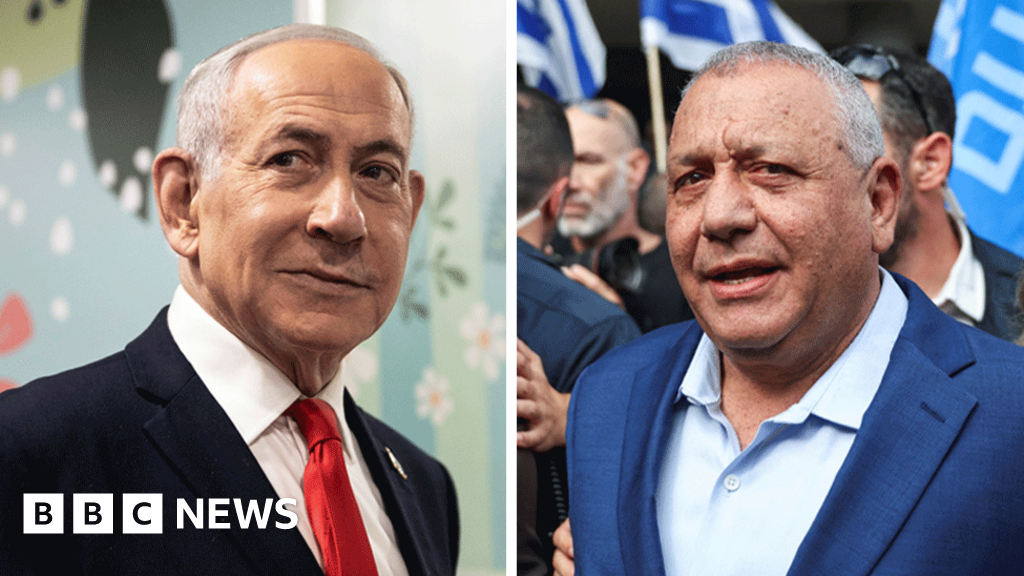
Israel’s caretaker Prime Minister Benjamin Netanyahu and opposition leader Gadi Eisenkot met on Sunday morning for substantive talks aimed at resolving the political deadlock created after last month’s elections. The meeting comes after a proposal by Netanyahu on Saturday, in which he expressed readiness to accept Eisenkot as first prime minister, as part of a rotating national unity government. The move marks a significant development in efforts to overcome the deep political impasse that has gripped Israel.
In October’s elections, Netanyahu’s bloc secured 53 seats, while Eisenkot’s centrist Yashar party and three other Hebrew opposition parties won 48 seats. Neither bloc reached the required majority of 61 seats in the 120-member Knesset, leaving the country in a deadlock. Eisenkot has only one week, until December 6, to form an administration before the deadline set by President Isaac Herzog expires. The president had consulted all parties after the elections before giving Eisenkot 28 days to form the government.
Netanyahu, in a social media post on Saturday, stressed that “my responsibility as a leader obliges me to set aside everything, including the principle of the largest party,” adding that he would initially serve as “alternate prime minister.” He justified his proposal for a unity government with “the magnitude of the existential danger and the possibility that a government may be formed that does not have the capacity to confront this danger.” This statement marked a noticeable shift in his position, opening the way for more serious negotiations.
Eisenkot, a former army chief, reacted immediately by inviting caretaker Prime Minister Netanyahu to “real and accelerated negotiations.” He had earlier accused, on Friday, Netanyahu’s right-wing Likud party of delaying coalition talks, claiming the party had not presented any concrete proposal over the past two weeks. In response to Netanyahu’s offer, Eisenkot said: “If Likud is ready for true unity, I am ready to assess the seriousness of its intentions over the next 24 hours.” He stressed that negotiations would be based on the “detailed proposal” sent to Netanyahu last Sunday, for which “to this moment, we have received no response.”
Eisenkot has made some progress toward reaching the required majority, agreeing coalition deals with Yisrael Beiteinu and The Democrats. The fourth member of his bloc, the Beyachad party, is led by former Israeli Prime Minister Naftali Bennett, who on Thursday expressed his support for a unity government that includes Likud, with Eisenkot as first prime minister. After Netanyahu’s comments on Sunday, Bennett assessed his decision as right, being “ready to join a unity government led by Eisenkot, a government based on an alliance of those who serve.”
Another important factor is the two Arab-led alliances, the United Arab List and the Joint List, which together won an unprecedented 19 seats after a rise in Arab voter turnout. This has positioned them as possible “kingmakers”; however, all but one of the Hebrew parties pledged before the elections not to cooperate with them to form a government. The leader of the moderate Islamist party Raam, Mansour Abbas, in an interview with Israel’s Channel 12 on Saturday, suggested that he and his party recognize Hamas as a “terrorist group,” confirming that he had voted for a bill co-sponsored by Raam that included this designation. Such a move could pave the way for his party to join a coalition to bring down Netanyahu. No political party in Israel has ever won an absolute majority, making all governments coalitions. The period 2019-2022, one of the most politically fragmented in Israel, saw five separate elections, as Netanyahu and his rivals repeatedly struggled to cooperate.
From BBC News