







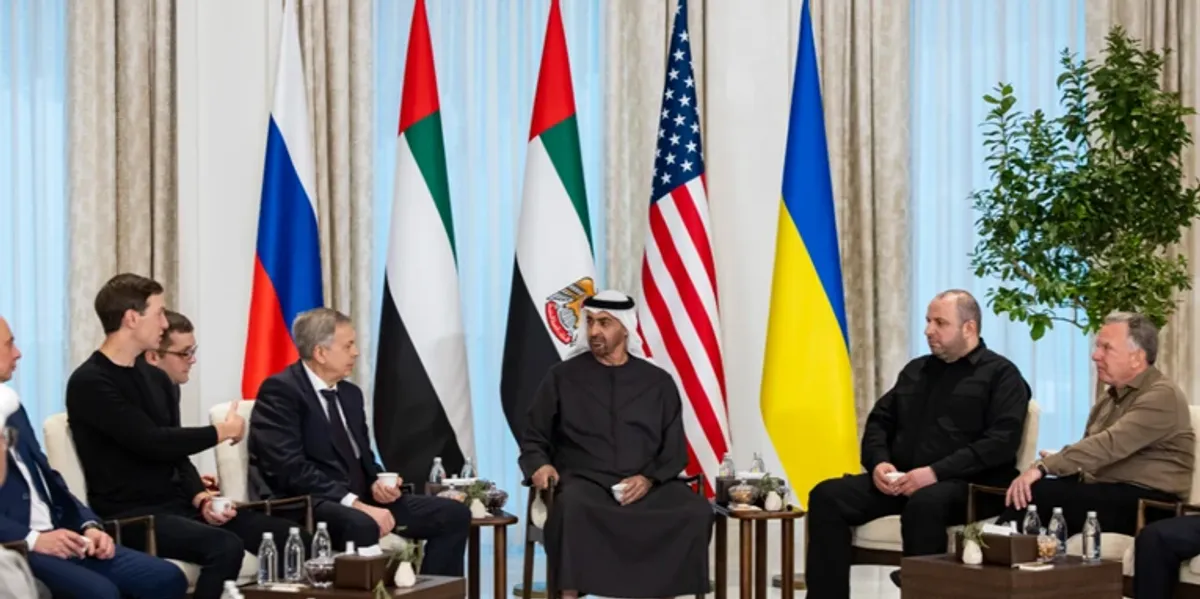
French Foreign Minister Jean-Noël Barrot said on Sunday that European countries will be represented in the talks between Russia and Ukraine. The talks are expected to begin on Tuesday in Abu Dhabi under the mediation of the United States. According to him, France will be present at the negotiating table.
He himself will not take part, Barrot added. The Russia-Ukraine talks in Abu Dhabi are scheduled for 10 and 11 November, according to him. He stressed that no agreement on the future of the continent can be reached without the involvement of Europeans.
“Europeans will be well represented and France will be in Abu Dhabi to take part in these talks,” he said in an interview with French radio RTL and Public Sénat. He added that it has not yet been decided who will represent France at the meeting. But he stressed that “no one will speak in our name.”

Barrot recalled that in recent weeks European countries had made their expectations and demands clear to American mediators. They explained that no discussion of the future of the continent can ignore them. The talks planned for 10 and 11 November were initially presented as trilateral negotiations between representatives of Ukraine, Russia and the United States.
However, Ukrainian President Volodymyr Zelensky had demanded that Kyiv’s European allies also be included in the process. US envoy Steve Witkoff said on Monday that Washington would bring together delegations from Ukraine and Russia on 10-11 November. They will discuss ending Moscow’s war against Ukraine, post-war security guarantees and de-escalation of tensions.
Barrot’s statements come after US President Donald Trump, following a meeting on Thursday with Russian envoy Kirill Dmitriev, predicted the imminent achievement of a “great deal” with Russia over Ukraine. According to Trump, the agreement could have an impact on all of Europe and would be acceptable to everyone.
He gave no further details. In an interview on Sunday, Trump said he believed the war would end soon. He suggested that Ukraine might emerge from a settlement with different borders.
“I think we will get it done, and I think it will happen and they will end up with a Ukraine that is somewhat different,” he said. Asked whether Russian President Vladimir Putin was stalling, Trump replied: “Oh, I don’t think so.” On Thursday, Trump told reporters that the war was close to a resolution and that its conclusion could involve all of Europe.
On Sunday, Secretary of State Marco Rubio said Trump was probably alluding to progress on security guarantees for Ukraine and Europe. These have been repeatedly mentioned in Russia-Ukraine talks. “What will the security infrastructure of Ukraine and of the wider European continent look like after the war?” Rubio told reporters.
“So, I think that’s what the president is alluding to, that some progress has been made on what that architecture might look like after the conflict,” he added. Trump’s envoy Jared Kushner said American officials held “productive and substantive discussions” with Ukraine, NATO and European partners in Brussels on Thursday.
The discussions focused on security guarantees for Ukraine and a broader European security architecture. Barrot said he did not know what the American president had in mind. He stressed that no agreement affecting European security architecture can be drafted or discussed without the participation of the countries of the continent.
The French Foreign Minister also criticized the leader of the radical left, Jean-Luc Mélenchon, describing him as a “spokesman for the Kremlin.” Barrot’s reaction came after Mélenchon’s statements during a rally in Le Bourget. There he spoke about the possibility of holding a referendum on the status of Donbas, a region largely occupied by the Russian army.
“It is the people who must decide,” Mélenchon had said. He opposed a peace agreement that would involve territorial concessions by Ukraine without first consulting the residents of the areas concerned. Barrot rejected this position.
He said the Kremlin is trying to convince international leaders that Donbas is Russian territory. According to him, the war against Ukraine is presented as an operation to liberate it. He recalled that Moscow previously organized so-called consultations in Crimea and in four regions of south-eastern Ukraine that it partially controls.
These processes have been rejected by Kyiv and the international community. According to Barrot, Mélenchon’s positions are particularly worrying. They make him unsuitable for the political posts he aims to win.
The war in Ukraine has already become one of the main issues in the political debate ahead of the French presidential election of 2027. Marine Le Pen, who leads in the polls, and Jean-Luc Mélenchon, currently ranked second, have taken positions that have been considered favorable to Russian President Vladimir Putin.
In mid-October, Le Pen stated that, if she wins the presidential election, she would end France’s financial aid to Ukraine. She estimates it at about six billion euros a year. Ukrainian President Zelensky responded by saying that Le Pen does not fully understand some aspects of military cooperation between France and Ukraine.
He defended the partnership between the two countries. He described it as a cooperation that benefits both sides and is also important for France’s security.