







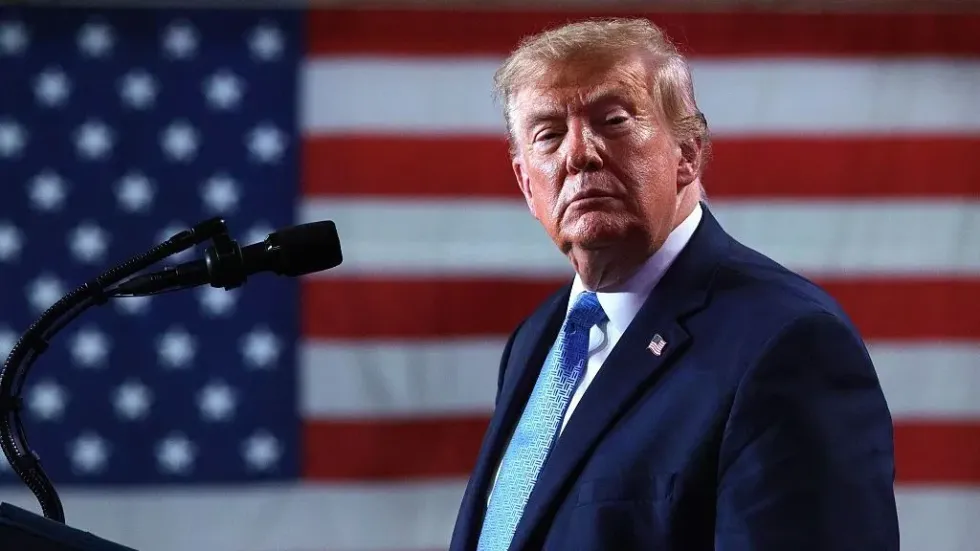
U.S. President Donald Trump has cast doubt on the credibility of the midterm election results, in which Republicans suffered sweeping defeats. This came only a few days after he had stated that he would accept the outcome of the vote. In a post on Monday on his Truth Social platform, the White House chief wrote: “Does anyone really believe these ‘elections’ were honest?
How is it possible that the polls were so wrong?”. The statement appears to contradict the position Trump had taken on election night, when he said he was “totally prepared” to accept the result. In last week’s elections, Democrats regained control of both chambers of the U.S. Congress.
According to results so far, they have secured 54 seats in the Senate and 254 in the House of Representatives, creating majorities in both institutions. Counting continues in several key races, including those for the Senate in Alaska and Mississippi. State and local officials across the country reported that the electoral process had largely gone smoothly.

In his post, the president raised vague claims regarding polling, vote tabulation and voting machines. He did not present concrete evidence to support his doubts, nor did he clarify whether he was alluding to errors or deliberate irregularities. ## Experts: vote reporting followed common patterns Charles Stewart III, a political scientist at the Massachusetts Institute of Technology, said the reporting of results during election night followed common patterns.
“Across the country we saw the standard vote-reporting patterns that we usually see,” he said. Stewart explained that in some states, such as Florida and Georgia, initial results are published more quickly, because votes cast early and by mail are processed before election day.
Ruth Greenwood, director of the Election Law Clinic at Harvard Law School, also said some states need more time to complete the count. “State laws and practical circumstances simply mean some states need more time to count the votes.
This does not mean that something suspicious is happening. We should trust local election officials to count every vote and to publish the results when they are complete,” she said. ## Blames war with Iran for defeat, accepted result on election night The overall result had become clear on election night.
At that time, Trump had said he would expect to work with the Democrats, adding that “we would probably reach a deal”. After the Republicans’ defeat in both chambers of Congress was confirmed, he told CBS News that “we would have won easily if I had been on the ballot”.
The president has also offered his own explanations for the defeat, acknowledging in an interview with Fox News that the war with Iran had affected the election result. “People agree with what I am doing in Iran, but perhaps they were not ready to endure the short-term consequences of paying more for gasoline.
I understand that”, he said. Vice President JD Vance has also blamed the war with Iran, which began in February and caused major disruptions to global oil and gas supplies, driving up prices. On the eve of the elections, several polls conducted by various companies and media outlets had predicted that Republicans could lose seats in both the Senate and the House of Representatives.
During the campaign, Trump repeatedly made claims of widespread fraud in the electoral process, even though such cases are rare. He and his allies had claimed for months that the 2020 presidential election, which he lost to former president Joe Biden, had been rigged against him.
Trump’s lawyers and supporters spent weeks trying to challenge the results in court, but their claims were repeatedly rejected. ## Preparations and lawsuits by the Department of Justice Meanwhile, the Department of Justice under his administration has made unprecedented efforts to expand federal control over electoral processes, although the Constitution mainly assigns this responsibility to the states.
Just days before the latest elections, the department filed controversial lawsuits in federal courts, challenging the counting and certification of votes in states such as California and Alaska. However, judges ruled against the administration in nearly all cases. Election law experts, state officials and local election institutions had spent months preparing for the possibility that the White House or groups skeptical of elections would question the legitimacy of the vote.
Despite the strong attention to the issue of electoral integrity, senior state and local officials have reported that the 2026 midterm election process has been largely calm. Extreme weather forced the closure of some polling centers, while in some areas administrative and technical problems were reported that caused delays in the process.