







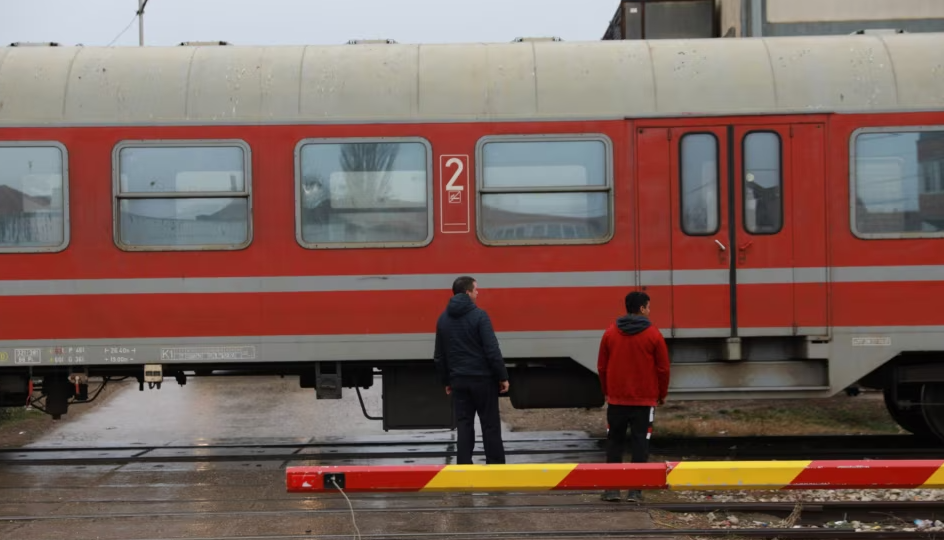
Train traffic for passengers in Kosovo was halted on November 9 due to a strike by workers of the public enterprise Infrakos, who are demanding wage increases in line with their positions and responsibilities. The suspension affected the Prishtina–Peja line, the only one currently operating for passenger transport in the country. According to a statement from the public enterprise Trainkos, the train scheduled to depart from Prishtina at 07:50 would stop its journey in Fushë Kosovë, since Infrakos had announced the suspension of infrastructure services from 08:00. The suspension of services has also made other services impossible until the situation normalizes. Trainkos, which is responsible for rail transport, said the interruption was caused by factors beyond its operational control and that services will resume as soon as conditions allow.
Why are the workers protesting?
Hysen Nikqi, from the Strike Council of Infrakos, told Radio Free Europe that the workers’ main demand is the indexation of wages for all categories of employees. According to him, dissatisfaction has grown after the minimum wage was raised to 500 euros from July of this year, since the wages of other workers have not been increased proportionally. This, according to Nikqi, has significantly narrowed the wage differences between employees with different qualifications and responsibilities.
“By decision of the Government, the minimum wage has now reached 500 euros and has affected a considerable number of workers. But the rest has been compressed, because wages have not been increased proportionally for all categories,” Nikqi said. He cited as an example the small wage difference between engineers and technical or service workers, saying the current wage structure does not reflect the responsibilities of each position. According to him, Infrakos has around 200 workers.

Nikqi did not provide figures for the average wage at the enterprise, but warned that the strike will continue in the coming days until the workers’ demands are met. Radio Free Europe also addressed questions to Infrakos management regarding the average wage of employees and possible steps to resolve the situation, but had not received a response by the time of publication. Infrakos and Trainkos are two public enterprises with different responsibilities. The former manages rail infrastructure, including tracks and the systems necessary for train operations, while the latter provides transport services. For this reason, Trainkos depends on Infrakos’s infrastructure services to operate trains, even when the transport company itself is not part of the strike.
Strike announced two weeks earlier
The suspension of train operations comes after a protest held by Infrakos workers on October 26 in front of the railway station in Fushë Kosovë. At that time, they warned that they would go on strike if their demands were not addressed by the company’s management. In addition to pay indexation, the workers demanded improved working conditions and greater safety. Trade union representatives criticized the company’s board and management, claiming they had taken no concrete steps to meet their demands. In public statements on November 9, union representatives also mentioned the demand for increased food allowances and retroactive payments for the last three months.
How did the minimum wage increase affect?
The minimum wage in Kosovo has risen considerably in recent years. From 350 euros gross in 2024, it increased to 425 euros in January 2026 and to 500 euros from July, according to the government decision adopted on October 31, 2025. This represents an increase of about 43 percent compared with the 2024 level. However, a rise in the minimum wage does not automatically mean proportional increases for employees paid above this level. This is precisely at the center of the discontent at Infrakos, where union representatives are demanding that wages reflect workers’ qualifications, positions and responsibilities.
Rail transport, with only one active line
The strike finds passenger rail transport in Kosovo with limited services. Currently, the Prishtinë–Pejë line and its return route is the only one operating for passengers, with two trips per day in each direction. According to data from Trainkos, over the past year more than 88,000 passengers used rail transport, about 20 percent more than in 2024. The suspension of Infrakos services thus means the halting of all regular passenger rail transport in the country.
Kosovo’s railways, between investments and delays
The suspension of train operations comes at a time when Kosovo’s railway sector continues to face infrastructure problems and delays in implementing investments. One of the largest projects is the rehabilitation of Line 10, which connects Kosovo with North Macedonia in the south and Serbia in the north, with the aim of improving regional transport and rail links. Although works began years ago, the project has not yet been completed.
In the report published on November 4, the European Commission assessed that progress in the rehabilitation of Line 10 remains limited. According to the Commission, works on the first two phases, which include the Hani i Elezit–Fushë Kosovë and Fushë Kosovë–Mitrovicë sections, have continued at a slow pace, focusing mainly on technically complex interventions on bridges and tunnels. The report also highlights delays in tendering the signalling and telecommunications systems, which are necessary to enable train speeds above 100 kilometres per hour.
Although the rail infrastructure crossing with North Macedonia has been completed, joint operations have not yet started. The European Commission asked Kosovo to accelerate the works and address the technical, administrative and institutional problems that are preventing the completion of the project. The Government of Kosovo pledged that it will take all the European Commission’s recommendations seriously and will commit to addressing them. /REL/