







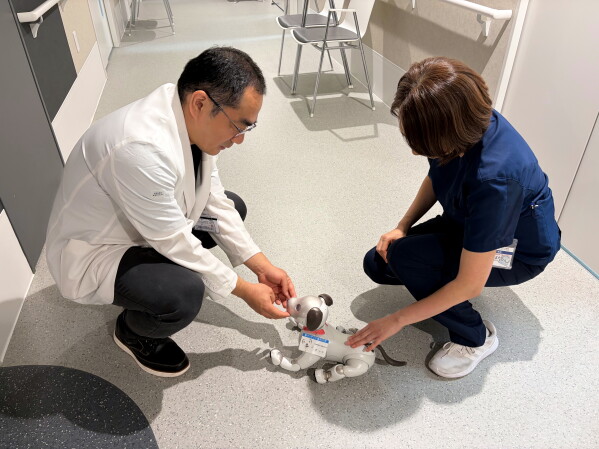
Sony does not refer to Aibo, the robotic dog from the Japanese electronics and entertainment company, as a simple “product.” The Aibo robots, first launched in 1999, have all been sold and are no longer produced. However, Sony Group Corp. in Tokyo has created an “adoption program” in which owners donate their Aibos, which then receive necessary repairs and upgrades, giving them a second life.
These pet robots now find new homes in hospitals and other facilities, offering comfort and smiles to patients and staff. Sony does not disclose details about prices or the number of Aibos sold. Equipped with sensors, digital cameras and a kind of intelligence, Aibo is programmed to remember its owner’s name, face and surroundings, creating a convincing illusion of personality.
Aibo simulates a real puppy: it barks, tilts its head curiously, moves its ears, walks with slow movements, shows happiness when petted and goes to “sleep.” In addition, it can take photos and continuously monitors its own mechanical malfunctions. Yoshiyuki Katsuno, a Sony official who oversees the program, emphasizes that owners feel as if they are parting with a child of theirs when they donate the robots.

Katsuno says Aibo encourages human interaction and offers emotional healing, helping tired souls find strength and carry on. He hopes to spread Aibo’s positive impact. At St. Marianna University School of Medicine in Kawasaki, on the outskirts of Tokyo, Aibo has helped with long waits for visiting patients and persuaded hesitant children to undergo examinations, according to Dr. Manabu Komori from the otolaryngology department.
Komori emphasizes that Aibo motivates children, making a hospital visit less unpleasant. This medical field, which deals with the ear, nose and throat, often has many child patients. While the hospital also uses real therapy dogs, which require constant care and food and can be temperamental, robotic dogs offer practical advantages. However, Komori was careful not to say that robots are better than real dogs.
In Japanese culture, “kawaii” (cuteness) is a highly desirable trait that encourages harmony and communication, not weakness or inferiority. Jerry Wang, Chief Executive Officer of FF EAI Robotics Ecosystem, agrees, saying that for emotional connection, a “cute form” is essential, whether that of a dog, cat or duck, in contrast to threatening-looking patrol robots. He emphasizes that if you want an emotional connection, you want a cute form.
Source: AP News