







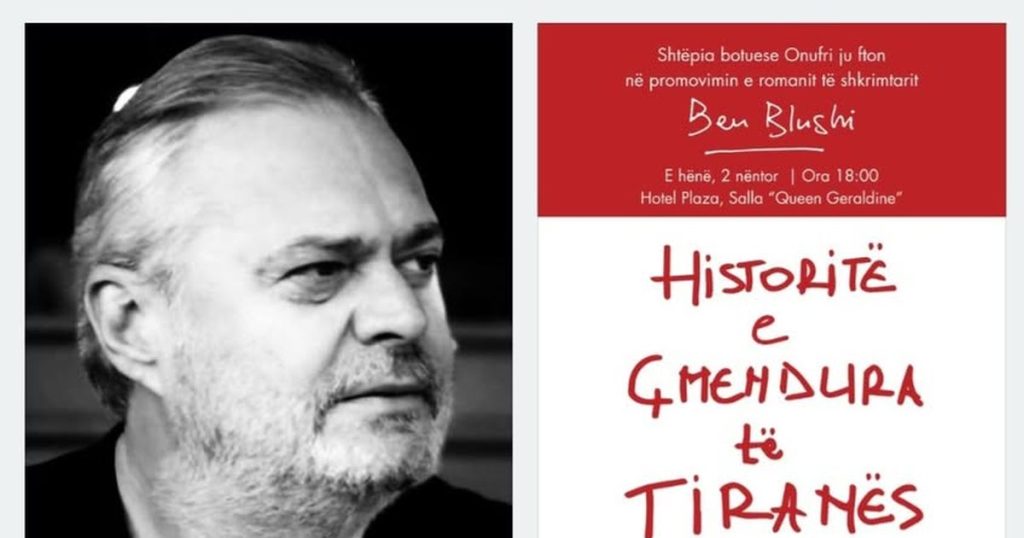
By Fatbardh Amursi (Rustemi)
I read Ben Blushi’s book “Historitë e çmendura të Tiranës” (“The Crazy Stories of Tirana”) in manuscript. As the first in line, I have the privilege of speaking before others. Written in one breath, from January to June of this year, thanks to a long accumulation, it gives the impression of a hastily written book, but in fact it is an inspired one.
Immediately, the inclusion of the capital’s 400 years makes one curious to know how the author has managed to keep the reader’s interest alive, without spinning it into stories of the “One Thousand and One Nights” type or into invented urban legends. So that the stories do not seem distant, the author has chose to write about well-known historical figures and about characters one encounters for the first time, who, taken together, may be far apart in time, by centuries or decades, yet all seem to be residents of the present. They resemble one another and alternate among themselves, despite the décor and clothing, where the hammam has swapped places with the toilet, or the castle with the towers.
The book begins with Sulejman Pasha Bargjini and ends with Leka Zogu, spanning a time arc of more than four centuries, yet it seems as if these men had met at the Bridge of Tabakë or at the Et’hem Bey Mosque, where Ahmet Zogu spent his last night before leaving, afraid the Italians might bomb the palace.
“Thus, a small peasant from Mullet became Sulejman Pasha Bargjini, with the speed of a farmer who today becomes a minister.” He takes from the goats and stirs up a commotion.
The founding of the capital cannot fail to draw attention: “The Pasha of Tirana wanted a virgin land, where no slaughter, no murder, no deflowering, no marriage, no betrayal, no ambush had been made, that is, which no one had yet defiled.”
Thus in 1600 and in 2000: “Leka’s arrival in Tirana was not a personal project, but the multi-year investment of a cemetery of rulers, carrying with it the four-hundred-year-old coffin of intrigues.” When the royal family returned, it brought with it tons of paperwork.
Before the mirror of a “virgin land,” all the sinners who have defiled this place see themselves, just as is happening even now. Therefore “The Crazy Stories of Tirana” is full of murders, idylls of rogues and erotica with split passions, cracked heroes, treachery and ambushes, where one must constantly be cleansed of the next filth, distance oneself from the remnants of the past, and where sinners powder themselves with a catharsis, like the self-criticisms of the communist era.

The founder of Tirana resembles a kind of prophet, “who demands that the future have no past,” yet the past keeps clinging to his feet, becoming also an object of this book. Kadare wrote about beys with party cards and red pashas, just as today’s leaders easily flatter them: “O king”?!
“Tirana was nothing but a wild forest that swallowed good people with the help of wild animals,” the author ironizes, and someone on the sidelines like me fully agrees with this observation. Those who are asked to leave are robbed.
The first two parties, that of the Tiranians and that of the Bargjinët with only girls, and that of the Krutanë or Toptanë with boys, made conflicts be resolved through marriage ties.
“Esat Pasha did not even want to become mayor of Tirana in order to grant building permits. He wanted to become king. In truth, he felt like a king,” while: “Ahmet Zogu was born a soldier, lived as a general, ruled like a marshal, but dreamed like a king.”
Everyone wants to strip off the “rags of slavery” and put on the old mantles of princes, counts and kings, but no one can bear to see the crown on another’s head. So, with ease, to save themselves from the demons of power, they handed it over to the Italian emperor.
It was said that Njazi Dede had been expelled from Turkey because he had not told the Turkish government the secret of Ashura. He dreamed that one day the Bektashis would have a state of their own. Njazi did not see dreams, and for several years he had suffered from insomnia. Not all visitors had the ability to put the grandfather to sleep.
In the end, they became known for putting people to sleep: “the heartless bookseller Dhimitër Canco, who bankrupted Mit’hat Frashëri, and a friend of his named Enver Hoxha, who sold cigarettes.” Known as a joker, Canco challenged Hoxha and Frashëri to a contest to see who could read a book by Karl Marx in one night.
“Enver accepted and, since he lost the bet, became a communist, while Mit’hat Frashëri, who was left without work, became a Ballist.”
The master of hypnosis for putting people to sleep is Enver Hoxha, an ability he would practice throughout his rule with brainwashing. The author has a phobia of telephones because of a story about teenagers who had gotten hold of the dictator’s secret phone number. They dialed the number and the leader woke up, leaving the secret police sleepless in their attempts to uncover the authors. Whoever woke Enver Hoxha from sleep ended up in prison.
Despite the marriage of the Tirana pasha’s daughters to the sons of the bey of Kruja, the author, not giving up his jabs, writes: “The forced marriage of the city with the hungry party of boarding students, founded in a canteen, created a new species that nowhere grew faster than in Tirana: kiosks.”
I first came across the word “kiosk” in Kadare’s poem “Vitet ’60,” which mentions the kiosks where newspapers were sold.
“Tirana was lit for the first time by an American spy who suffered from malaria. Neither the Austrians nor the Italians, who had occupied the city with engineers, could light a single lamp before this man shaking with fever, when the lights came on in the parliament hall in the spring of 1922.”
The first place to be lit by electric light was Buffalo Boulevard, thanks to Tesla. I have taken photos on this boulevard. Not far from there, Mustafa Kruja died.
“Compared with the petty ambassadors of our days, who from the parliament’s galleries tell deputies how to vote, Harry Fultz looks like a god who holds the source of light. Whenever things went well for him, the city was lit up, but when he was annoyed by the deputies’ decisions, Tirana sank into darkness.”
I have no need to explain his irony, for its barb lands like a nail splitting a board.
There are many interesting figures in the book, but I will pause on one of them, since in him you find both the politician and the writer.
“Most of Haki Stërmilli’s life was erased by himself, using the three cunning tools of the writer: will, talent and fear. His diaries resemble an hour in which the time when he worked for Ahmet Zog and his chattering sisters is missing… Haki Stërmilli suddenly became the chief of the devils, whose only job was to catch as many angels as possible.”
No writer in world history has known more secrets than he did. Everyone’s soul became the property of Haki Stërmilli; every debt, every vice, every mistake, every betrayal, every phobia, every obsession went into small files tied with red ribbon before being presented to Zog as a gift.
Haki Stërmilli, from private tutor and head of the household, was sentenced to five years in prison as a conspirator, without having any other luck like those Enver Hoxha condemned. Personalities from around the world protested his imprisonment. Lost, shaken and bent, he trampled even on his own dignity.
“Whenever Zog had his birthday, on the table he found a letter from Haki Stërmilli, in which beneath the sweet language of the greeting hid the flattery of mercy.”
The writer was freed when he admitted that the man who had imprisoned him was a genius. He opened a shop selling lamps and wrote a poem for Prince Leka. He published a book about love, which restored the honor he had lost. When he walked along the boulevard, people queued to meet him, women spoke of his elegance, cars swerved onto the curb out of joy, shoeshine boys polished his shoes for free, while at society parties his presence caused a stir.
Writers who described mountains and fields understood that love sells. Within a few months the novel was reprinted twelve times. Brilliance and fall, or the reverse, accompany all our historical figures.
In a small town there is a big problem: “The insults that happen there turn into wounds that cannot be healed.”
If Marko von Toptani took someone’s lover after beating them, he astonished everyone when he declared that he had become a captain in the German army. “This is the revenge of a narcissist who became a Nazi to dress up nicely.”
In contrast, the anarchist Teodor Keko, intoxicated by a revolution that was not coming, when everyone claimed to be great, chose to be called Little Dori.
Emperor Victor Emmanuel III had slept in the hotel where Vasil Laçi worked as a room cleaner, and “when he smelled a pair of unwashed socks, he was disgusted and decided to kill him. Perhaps in world history no emperor has been killed for a weaker reason, but the poor waiter was also driven by a patriotic motive. He could not accept that the emperor of his own country could be so filthy.”
The adventurer millionaire de Kay, who had overthrown a government over a tone of sausage and who had covered the most dissolute actress in the world with gold, decided to live in Tirana, buying the state.
“Not that this city lacked plenty of deceivers, but the deception that came after a joy was not easily swallowed.” To know such an interesting character, you must read the book.
“How the truth returns, in a stew of lies, from whose fat the stomach vomits all kinds of slander that must not be believed,” the author writes, as if to add the reasons why good people are expelled and why there are so many adventurers.
“Because of the books he distributes for free, filling home libraries, the peoples still tremble before tyrants. And they are right, even though they believe a lie. Unfortunately, the peoples who have cut off the heads of so many tyrants, driven by the deceptions of Greek philosophers, do not know the crazy stories of Tirana, this courageous city that is not afraid at all of the tyrants who still run it.”
Apparently, because they are not afraid of them, they keep them in power for a long time.
“Without the cunning of women, Tirana might not exist today, and we might be citizens of Kruja or, as is well known, even of Kavaja, which has slightly milder winters,” he writes, giving credit to Kimete Berisha, when she writes: “Albanians have never conquered anyone, except their own wives.”
On the board of a capital city: “Gossip is wild, coarse, hurtful, and the one who invents it has no need for proof. Indeed, when there is no proof, gossip does even more harm. Being the fruit of men’s spite, gossip is created in taverns, which is why it is more masculine. Whereas gossip, which does not carry the smell of meat and raki, resembles a bottle of perfume that, once opened, releases a light aroma that pricks the nose in a pleasant way. It does not kill, but it entertains… In Albanian the word gossip would be translated as çuçurimë, that is, a playful chu-chu-chu that comes out of a woman’s mouth, enters the ear of another lady and from there, sailing on the boats of earrings, enters hundreds of other ears.”
Like the gossip of men, so the gossip of women has not spared a single writer of note.
“Unfortunately, like all submissive and hardworking peoples, the Illyrians had one small problem: they did not know how to sell.”
In the marketing that Ben Blushi is doing for his books, it seems he is correcting this flaw. Wait until they tell me: an ability that they borrowed from the Jews.
“I grew up in queues. I don’t remember when I first woke up at four in the morning to buy a bottle of milk, which I never drank.”
It is nice to see that your readers queue to buy the book. Something we wish the author well for.