







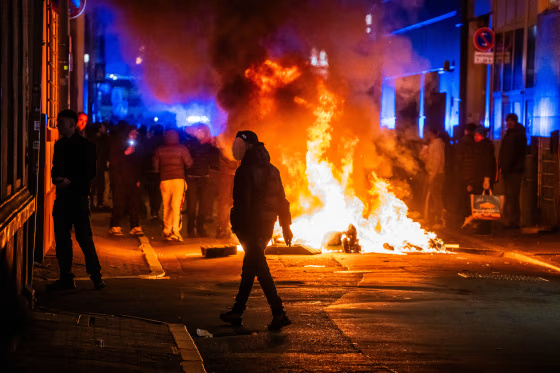
Violent protests broke out in Germany on Saturday, with shops looted and barricades set on fire in Frankfurt, while tens of thousands of activists from “Gen Z regelt” (Generation Z Takes Charge) took to the streets in more than 30 cities, including Berlin and Frankfurt’s financial center. The demonstrations called for lower living costs, better education, climate protection and solutions for housing, and also opposed plans to reinstate compulsory military service. Frankfurt police reported broken windows at several shops and Molotov cocktails thrown at emergency services, and urged residents to avoid the city center. In Hamburg too, several barricades were set on fire, while other businesses had already boarded up their windows and doors.
Lina Friedrich, spokesperson for “Gen Z regelt”, stated in Berlin that their goal was “to fight for peace and freedom, instead of war and compulsion”, adding that the priority was “better support for health and education systems”, as well as opposition to compulsory military service and support for a fairer distribution of the burden. However, the official number of participants on Saturday afternoon was lower than the 182,000 expected by the organizers. These protests in Germany took place alongside numerous other demonstrations across Europe, driven by similar causes.
In France, student protests over the state of education last month turned into broader demonstrations against the cost of living and social security, with footage of looting and fires in Marseille. Hesse’s Interior Minister, Roman Poseck, warned Germans not to follow the example of the violence seen in France. Italy has also seen unrest, where Giorgia Meloni’s government deployed 500 military personnel in Milan after shops were looted and masked protesters attacked police. Tens of thousands of people took to the streets of Rome and other cities, where police used water cannons and physical intervention to disperse crowds, although most demonstrations were peaceful.

In Serbia, student-led activism helped bring down the country’s leader through the ballot box, while in Portugal, police forcibly dispersed a tent camp in Lisbon set up by activists protesting high housing costs. Although the protests on the continent have drawn comparisons for their timing, Andrew Barclay, a lecturer in politics at the University of Sheffield, stressed the importance of focusing on their differences. He noted that the French protests involved hundreds of thousands of people over many weeks and initially focused on funding for education, whereas those elsewhere, though they may have drawn inspiration, have not reached the same scale and have expanded to include a wider range of grievances. Barclay added that the protests in Germany and France are unlikely to lead to a direct change of government as happened in Serbia, since protests, even large ones, often fail to gain that level of support in other parts of the country.
Taken from NBC News